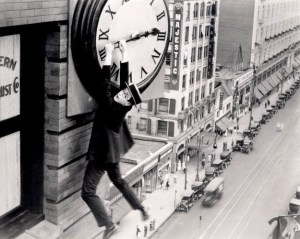
 This one really happened – and it happened to yours truly (as opposed to the usual disguised anecdote loosely based on a factually altered tale from one or more carefully anonymized clients.)
One night, (or morning, or sometime between night and morning, since we were working an all-nighter) shortly after my arrival at Sullivan & Cromwell, a fairly senior partner at the firm took a moment to lean back in his desk chair and impart the following to little junior associate moi:
“You hang on by your fingertips, kid.” He raised his hands and bent his fingers, as if to demonstrate. “Till it starts to seem normal. Just dangle there and wonder how long you can last – or what happens if you let go.”
Apparently that was all he had to relate on the topic, as he snapped back to focus on reviewing a purchase agreement. I recall wondering if he, after (presumably) a zillion sleepless nights just like this one, felt as bleary-eyed, sweaty and slightly sick to his stomach as I did. I’ll never know the answer to that question. Maybe partners don’t need sleep – maybe that’s their secret.
I also recall wondering if this guy was exaggerating with that whole “dangling by your fingers” routine to impress me – or if he was a little bonkers. In retrospect I think he simply meant it.
Working in biglaw is a straight-forward exercise: You’re paid a lot of money to sit at a desk and work long hours. Someone provides the work, and you do it. That typically means arriving at around 10 am, working on something complicated, with a short break (maybe) for lunch, and then (maybe) for dinner, until about 10 or 11 pm, every day. You also sometimes work all night and sometimes weekends and sometimes all night on weekends.
To review: You arrive in the morning, you sit at a desk, you work until late night. Then you do it again the next day.
An additional factor is that the work is hard. Not rocket science hard, but not stuffing cotton into little bottles either. Initially, there’s a lot of “running changes,” “creating a chart,” “putting it into a table,” “checking cites,” and that sort of thing. Even that stuff can freak you out when nothing you give them is ever what they want and they keep handing you more. “Firm culture” can take getting used to, as well. A junior associate client of mine closed her office door one night, as was her habit, so she could break down and have a good cry, only to realize (through the paper thin walls) that someone else was also weeping, in the office next door. There’s nothing like feeling part of a team.
 Our initial task as client and therapist – our work during the first few sessions – resembles cartography. I begin, like a map-maker, drawing a square or a rectangle, then sketching the outlines of landmarks visible from afar – the mountains, the sea, the rivers. In limning a life, the prominent features are obvious – where you were born, and when, where you grew up, what you do for a living, who your parents were and what they do, your siblings, if you have any, and your relationships with them, your partner, if you have one, and your relationship with him. I get the big stuff down, then step back, and try to make sense of it all – take “the lay of the land.” Later, I’ll add shading and nuance, and fill in the details – tiny inlets and hillocks, copses and rills.
 The first step in the process comes as a question from the therapist. The phrasing of that “first question” gets debated when therapists gather. I trained with a colleague who invariably asked the same thing at each first session: “So what brings you here today?” That feels twisty and indirect to me. I usually start with “So how are you?” or, depending on my mood, or yours, “So how’s it going?” Sometimes there’s serious upset taking place in the here and now, that needs attending to right away. Before I sketch the background – the mountains and the sea and the rivers – I need to know if there’s a battle occurring on that stony plain, a castle under siege, a forest caught fire.
 What is it about lawyers and vacations? Like the old saying about long-horn cattle and a Texas fence – they just don’t get along so good. It’s like a physical aversion.
 I write a lot about unconscious regression – mostly how to prevent it.
 You also need to play. Perhaps that’s what dreams are – the play of the unconscious mind.
 Adults do just the opposite. When you play as an adult, you regress back to childhood activities. You might occupy yourself with sports, vegetate with a video game or disappear into a novel or a movie. You might sit on the beach, look at a palm tree and think about the world.
 The German philosopher, Friedrich Nietzsche, wrote that a man who transcends the conventional thinking of his time “must be accustomed to living on mountain tops.”
 But for a few days I’ll let my child take over.


 The People's Therapist