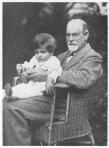
 At the end of Beyond the Pleasure Principle, there’s a moment where Sigmund Freud pauses to admit he’s gone out on a limb exploring his own ideas:
I do not know how far I believe in them…One may surely give oneself up to a line of thought, and follow it up as far as it leads…without, however, making a pact with the devil about it.
Hallelujah. Not even Freud was a “strict Freudian.”
A new client showed up at my office a few weeks ago. He said he was interviewing therapists. His current therapist wasn’t working out, and he was going to several others to see if they were more what he needed.
I said sure. And I sat Simon, my miniature wire-haired dachshund, in my lap and scratched his ears.
The patient stared at me. I stared back.
“Would you like to hold Simon?”
It turned out this patient’s old therapist was very formal. In fact, he wore a suit and tie and enforced strict rules. Every session began the same way, with the therapist observing the patient in complete silence, waiting for him to begin. This therapist would sooner wear a polka dot dress than have a fuzzy dog in his lap. My patient admitted he found the whole set-up intimidating, like he’d been sent to the principal’s office.
 I suppose there’s nothing wrong with doing things with a touch of formality – we all have our personal style. The mistake is when you start to think your way of doing things is the only way. That’s when you start making a pact with the devil.
Every patient needs a slightly different therapist. That’s because every patient is a slightly different person.
I started out as a therapist using the couch. My patients took off their shoes, lay down, and I sat on a chair behind their heads. The idea was that they couldn’t see me, so they could free-associate without distraction.
Unfortunately, I didn’t have a proper psychotherapy couch – I had a sofa, with arms.
One patient was too tall. His feet had to be propped up on the arm of the sofa. It was an awkward arrangement.
At some point he looked up at me and said, “would it be okay if we just sat up and faced each other?”
I was going to start on a speech about how important the couch was to free association, but I didn’t have the heart for it. Maybe the couch wasn’t all that important. One of the reasons Freud used the couch, or so it’s been said, is that he hated having his patients stare at him for hours. Maybe it made him nervous.
We ended up sitting cross-legged on the floor for the final year we worked together – and we did just fine.
My point is that a lot of the details don’t matter that much in psychotherapy.
I know a therapist colleague who began wearing a formal suit and tie to sessions – until his patients told him to knock it off.
I used to wear khakis and button-down shirts during therapy. It seemed formal enough, but not too formal. At this point I’m typically in jeans and a polo shirt. Last year I took a leap into the unknown and started wearing shorts. It was summer, and hot, and my patients were all showing up in cut-offs and flip-flops. Fair’s fair.
 The art in your therapist’s office doesn’t matter much either. I’ve moved paintings around and fiddled with the decor only to realize my patients never noticed or cared.
If there’s anything that does matter, above all else – it is that you loosen up with a therapist, and he loosen up with you, so you can both be yourselves and explore someplace new.
I’m a relaxed guy who likes to have my dog in my lap.
At this point, my patients usually sit in a chair, or flop down on the couch, or occasionally sit on the floor. Whatever feels comfortable is okay with me.
The greatest danger in psychotherapy is when you stop realizing that it is an on-going experiment – an improvisation – and begin believing your own dogma. That’s when you risk driving right off the rails into who knows where.
There was a time during the last century when reputable therapists actually used psychotherapy to try to “cure” homosexuals. It is hard to fathom how a therapy that is all about awareness and acceptance of the authentic self could be misused in a more malicious and stupid way. But they thought they knew what they were doing and they had a lot of fancy-sounding theoretical mumbo-jumbo and books by psychoanalysts with impressive-sounding names. They had impressive degrees hanging on their walls, too. I’m sure they were very formal and “strictly Freudian” about it – although every single aspect of their work violated the essence of Freud’s thinking.
 A pact with the devil.
Freud was an explorer. He accomplished breakthroughs in how we understand the human mind. That’s because he took risks, and was ready to admit when he’d driven up a blind alley. One of the interesting and for some, frustrating aspects of Freud is that there is no one book of his that contains all his ideas. In fact, some of the ideas in later books contradict things he says in earlier books. That’s because Freud made mistakes, and changed his mind, and never stopped exploring.
For a while, he thought cocaine was a wonder drug. That didn’t last long.
Many of his theories came from explorations of his own psyche – “self-analysis.” When that process worked, it was brilliant. Freud was capable of feats of honesty about himself, honesty that brought shattering insights. On the other hand, some of his ideas, like the “Oedipus Complex” probably tell us more about Freud’s family history than any generalizable theory of human nature.
Sometimes you have to lose your way to find yourself someplace new. Never assume where you happen to end up is the only possible destination.
And don’t make a pact with the devil. Reserve the right to change your mind.
 For the record, Simon and I are strict Freudians. Freud kept a dog in his office during sessions, too. According to Peter Gay:
…Freud and a succession of chows, especially his Jo-Fi, were inseparable. The dog would sit quietly at the foot of the couch during the analytic hour.
Far be it from me to betray strict Freudian doctrine by performing dog-less psychotherapy!


 It turns out that A.M.’s question was a two-parter. Here’s part two:


 Albert Einstein was puzzled by the mystery of his own fame. He was forever pondering with friends and associates why he – a physicist whose work was a mystery to most non-scientists – should have become the recipient of full-blown Hollywood-style celebrity. For whatever reason, Einstein chose not to discuss this issue with the father of psychoanalysis, Sigmund Freud, either when they met in person in 1927, or in their later correspondence. As one of Einstein’s biographers, Denis Brian, put it:
 Why? Because that’s what most people assume they want, until they stop and think, and maybe come up with an answer that’s a little more meaningful.
 Money, in psychotherapy terms, is a surrogate for security in love. A patient once told me if he won the lottery he would build a brick house that needed no maintenance and would stand for five hundred years, then he’d create a fund to guarantee that the taxes and every other possible expense would be paid for in perpetuity. He’d have a place, a safe place, forever, that no one could ever take away. He could finally feel safe and breathe free.
 As a child, you can gauge your parents’ investment in you – their love – by whether they are paying attention. You learn to do everything you can to keep their eyes on you as much as possible – like a kid at the playground, calling to his mother, making sure she watches each and every trick he performs on the jungle gym. Attention is like food for a young child.
 There’s evolutionary history behind our desire to be rich and famous. It traces back to the fact that humans, with their gigantic brains, take a long time to reach maturity. An orangutan reaches adolescence at about age four. He’s in contact with his mother’s skin almost without break for much of that time, then soon becomes independent. A human doesn’t reach adolescence until thirteen. He requires more than a decade of childcare – too many years to rely solely on the care of parents. The human child senses instinctively that his life might depend upon summoning care and attention from others.
 The problem with chasing wealth and fame is that it’s a child’s mission, not an adult’s. At some point you must step out of childhood – that long, helpless period of your life – and move onto the independence of maturity. Instead of needing reassurance that you are loved, you can achieve independence by learning to love yourself. That big step into adulthood is an affirmation that you deserve love, and deserve to receive it from those you call friends or partners.
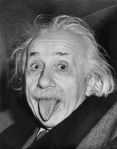 It’s interesting that one of the most famous photos of Albert Einstein features him sticking his tongue out. You’ve probably seen it a million times on postcards or posters on dorm room walls. It seems to speak volumes about Einstein’s naturalness and lack of pretension – his being in touch with his child. Perhaps that’s true. It was photos like that – and his crazy hairdo – that helped make Einstein an icon of approachable, lovable brilliance.
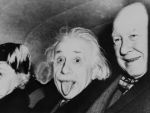 The original, un-cropped version of the photo gives a slightly different impression from the familiar cropped version. The original includes the people around Einstein, who are trying to hurry a sick man home through a crowd of reporters. Perhaps, when he stuck out his tongue, Einstein the adult was simply annoyed and exasperated at a mob harassing an aging, unwell physicist whose work none of them could even understand.


 The People's Therapist