Feeds:
Posts
Comments

Archive for the ‘Thoughts and Musings’ Category

It seems oddly fitting that the words “caregiving” and “caretaking” mean precisely the same thing.  Perhaps that linguistic oddity reflects the salient characteristic of care itself:  a tension between our desire to receive it and our countervailing feeling of obligation to provide it.  Human relations, generally, can be summarized as an on-going battle between those who provide care and those on the receiving end.

As a human child, you started out your life as the ultimate care-collection machine.  Children are designed to make you want to provide them with care – and you’re designed, as an adult, to feel a profound impulse to provide children with care, especially your own children.  It’s no coincidence that anything you identify as “cute” – i.e., feel an impulse to care for – will have child-like features, such as large eyes in proportion to its face and a large head in proportion to its body.   These are all evolutionary triggers designed to make us feel like providing care.

The human instinct to care for youngsters transfers over to other young animals as well, and explains, at least in part, your relationship with “man’s best friend.”  Everyone loves puppies – baby dogs.  But with canines, the phenomenon extends further than that.  Adult dogs retain many juvenile features – a phenomenon called “neoteny” – because by continuing to appear puppy-like up to and through adulthood, they can convince humans to keep wanting to offer them care.  Dogs literally evolved to look young and cute just so you would care for them – and it’s worked!  Unlike most species, the dog’s trick to evolutionary success wasn’t to display aggression, like a wolf.  As evidenced by the wolf’s current struggle to survive in a human-dominated habitat, ferocity only gets you so far.  For the dog, docility, rather than aggression, was the answer.  By appearing cute – a bit like our own young – they mastered a strategy of symbiosis with another species, humans, with a strong instinct to provide care to their own young.  The result is humans calling their dog “baby” and bragging to their friends that he’s “just like a member of the family.”  In many respects, Fido actually is just like another child.  Dogs are a bit like cuckoos in that respect – enlisting another species to do the work of raising their young – but in this case, by remaining young-looking throughout their adulthood, they lead another species to treat them like its own children for the duration of their lives.

Human children are also master care-harvesters – they have to be, because they remain dependent on adult care for survival for much longer than other species.  Adult humans possess large brains, which could never fit through the human birth canal.  Our children are thus, of necessity, born with a relatively tiny, undeveloped brain, leaving them utterly helpless and dependent on the care of others for many years.  Humans thus possess a strong instinct to summon care as a child, but also a corresponding (and conflicting) instinct to provide care for helpless young humans.  Awww…it’s a cute little baby.  I want to take care of it.

Thus do we perpetuate our species.  But this evolutionary arrangement sets up an internal battle between the child within you who’s hungry for care and the adult who feels obligated to provide it.

(more…)

Read Full Post »

I had the pleasure of sitting down for an interview last week with Spencer Mazyck, of Bloomberg Law, at their studio in Midtown.  I’m happy to report Spencer is the nicest guy in the world and this was the most fun I’ve ever had.

The discussion was far-ranging.  I’m used to talking about the state of the legal profession, but Spencer asked me about my life, my loves – and just about everything else.

Here’s the interview:

Please check out The People’s Therapist’s legendary best-seller about the sad state of the legal profession: Way Worse Than Being a Dentist: The Lawyer’s Quest for Meaning

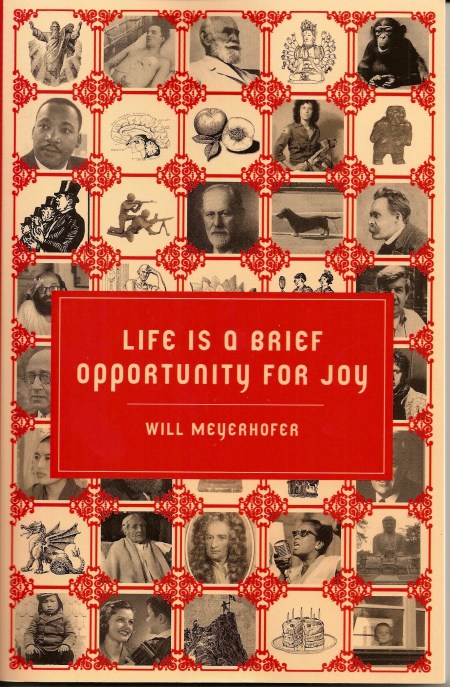
My first book is an unusual (and useful) introduction to the concepts underlying psychotherapy: Life is a Brief Opportunity for Joy

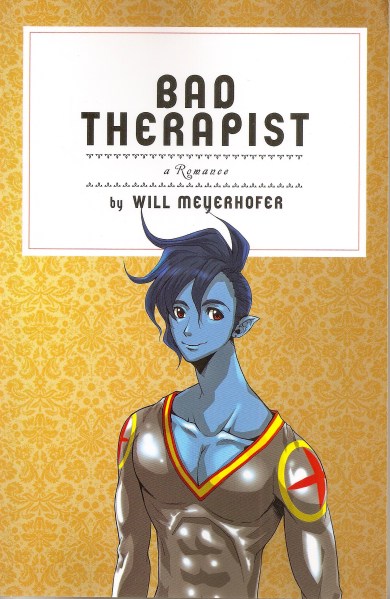
My new book is a comic novel about a psychotherapist who falls in love with a blue alien from outer space. I guarantee pure reading pleasure: Bad Therapist: A Romance

(In addition to Amazon.com, my books are also available on bn.com and the Apple iBookstore.)

Read Full Post »

talking-headsThe People’s Therapist has joined the bloviating classes…I’ve now appeared as a talking head on a real live (sort of) television talk show – HuffPost Live.

Anyway – here’s the link.

The segment seemed to go well, although I had the unnerving if not atypical sensation of being the hot-headed radical spouting fire at a garden party.  Hélas, c’est mon destin.  At least my hair looked good.  At least, I think it did.

This time around, blessedly, the other panelists weren’t biglaw partners, law professors and authors of books with titles like “You can be super-duper happy as a lawyer if you just smile a lot!”  Been there, done that.

For a rather gloomier view of the current nightmare that is biglaw, click here.

It must be admitted, it is fun to be on tv and get to talk.

==========

My new book is a comic novel about a psychotherapist who falls in love with a blue alien from outer space. It’s called Bad Therapist: A Romance. I guarantee pure reading pleasure…

If you enjoy these columns, please check out The People’s Therapist’s book about the sad state of the legal profession, Way Worse Than Being a Dentist: The Lawyer’s Quest for Meaning

My first book is an unusual (and useful) introduction to the concepts underlying psychotherapy: Life is a Brief Opportunity for Joy

(My books are also available on bn.com and the Apple iBookstore.)

Read Full Post »

My new book is out.  It’s a comic novel about a psychotherapist who falls in love with an alien from outer space.

From start to finish… pure reading pleasure.

Buy it at Amazon Bad Therapist: A Romance.  Buy it at BN.com.  Also available via the Apple ibook store.

Image

Read Full Post »

First – yes, this blog, and my columns on AboveTheLaw.com, are coming back to life – or will be shortly. I’m just waiting for the new book to come out (and no, the new book is not what you’re expecting.)

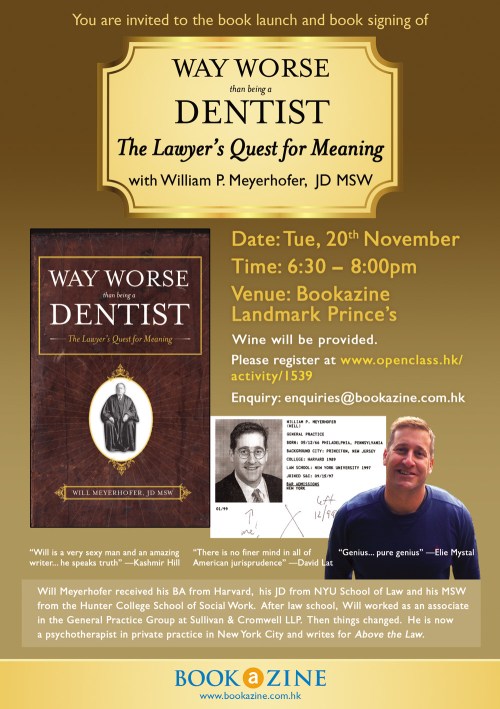
More immediately, for all my Hong Kong readers, here’s a fun event coming up on the evening of November 20th, 2012, featuring wine and canapes:

I look forward to the opportunity to meet more of my readers and share a few thoughts about the madness of biglaw. Hope you can make it.

Will

PS: If you’re in NYC On October 26th, 2012 and would like to hear me opine upon the divine absurdities attendant to biglaw, please come to the 2012 Fall Symposium of the National Association of Legal Search Consultants (NALSC), where I’ll be a featured speaker – information is available here.

========

If you’re interested in the scientific and philosophical underpinnings of psychotherapy, you might enjoy my first book, Life is a Brief Opportunity for Joy

My second book takes a humorous look at the current state of the legal profession, Way Worse Than Being a Dentist: The Lawyer’s Quest for Meaning

(Both books are also available on bn.com and the Apple iBookstore.) 

For information on my private practice, click here.

Read Full Post »

Our initial task as client and therapist – our work during the first few sessions – resembles cartography.  I begin, like a map-maker, drawing a square or a rectangle, then sketching the outlines of landmarks visible from afar – the mountains, the sea, the rivers.  In limning a life, the prominent features are obvious – where you were born, and when, where you grew up, what you do for a living, who your parents were and what they do, your siblings, if you have any, and your relationships with them, your partner, if you have one, and your relationship with him.  I get the big stuff down, then step back, and try to make sense of it all – take “the lay of the land.”  Later, I’ll add shading and nuance, and fill in the details – tiny inlets and hillocks, copses and rills.

I conjure a map from blank parchment.  It returns the favor – conjuring a New World from my collected observations, and serving as a trusty guide.  The expanse charted in shorthand on the map permits me to “rack focus” (as they say in film-making) – alter my gaze to take a fresh perspective, observe an unaccustomed vista. The map, as it develops, assumes a shape of its own.  Disparate regions are drawn together by common threads – the length of a river’s course, a shared coastline or mountain range.  My attention drifts to objects on the edges of boundaries, features I might have missed.  The elusive “big picture” – awareness, the ultimate goal in psychotherapy – begins to coalesce.

The first step in the process comes as a question from the therapist.  The phrasing of that “first question” gets debated when therapists gather.  I trained with a colleague who invariably asked the same thing at each first session:  “So what brings you here today?”  That feels twisty and indirect to me.  I usually start with “So how are you?” or, depending on my mood, or yours, “So how’s it going?”  Sometimes there’s serious upset taking place in the here and now, that needs attending to right away.  Before I sketch the background – the mountains and the sea and the rivers – I need to know if there’s a battle occurring on that stony plain, a castle under siege, a forest caught fire.

This is an historical map.  I am mapping a quest – an epic voyage.  You are the hero. Ours will be the sort of map with crossed swords to mark battlefields and mythic beasts to guard those unexplored zones at the edges of awareness.

The first question doesn’t matter much, because your unconscious feelings function like a compass.  Wherever you start, you’ll find yourself where you need to be.

I have a good sense of direction, too.  If I sense we’re drifting off-course, I’ll lean my elbow on the tiller.

Your compass is guided by emotion, drawn to it as to a magnetic pole.  If I detect an increase in feeling, I might grow cautious, slow our pace and sniff the breeze, comb the sky for a cynosure – fear, anger, sadness, hurt.  Emotions guide our way.

(more…)

Read Full Post »

On my private practice website it says, right after my name, “Integrative Psychotherapy.” A number of people have asked me what the heck that means. Good question.

There’s room for argument, but so far as I’m concerned, there are two chief meanings.

The first is a bit technical.  It means I integrate the two leading schools of psychotherapy – psychodynamic and cognitive-behavioral – into one eclectic approach.

Huh?

You can think of the two schools as vertical versus horizontal.

Psychodynamic work is vertical.  It involves digging down into your past, looking for the root sources of your behaviors.  When I work psychodynamically, I’m wondering when you started thinking or feeling a certain way.  I want to make you aware of how the environment in which you grew up shaped the person you are.

If you always seem to expect honesty to be received with punishment, and so avoid telling people what you really think, I’ll wonder where that pattern started.  Maybe you had a punishing parent, who responded harshly to being told the truth because she had trouble tolerating the reality of a situation.  You may have observed that response to you when you were a kid, spotted a feedback loop of sorts (telling truth = bad response), and formed expectations.  These expectations let you to adapt a strategy for survival (avoid telling truth = avoid bad response.)  These sorts of strategies – learned behaviors – may continue to take over unconsciously today and lead you to sabotage your conscious goals in life.  To address that situation, you need to understand where and when they started, so you can decide if you’d like to abandon learned behaviors which have become maladaptive to your life as an adult.

Cognitive-behavioral work, in contrast,  is horizontal.  I’m not so worried about the source of the behavior – I’m dealing with the here and now, trying to make you more conscious of your current thoughts and how they’re controlling your actions.

If you have a phobia about flying in airplanes, I will likely employ cognitive-behavioral techniques to make you conscious of the thoughts – predictions – that are frightening you.  These thoughts are like tapes that play in your head – if you become aware of them, you can turn them off, and play another tape that will soothe you instead of freaking you out.

You might have a fear of plunging from a great height if a plane crashes.  Once you understand that thought, you can reality-test it.  Yes, it could happen that you would plunge in a plane accident, but it is exceedingly unlikely, since you’d most likely die quickly or fall unconscious – and in any case, it might be a risk worth taking, once you balance the enormous benefits of air travel against the very small risks of a crash.   You could learn to formulate counter-messages to address frightening thoughts, perhaps something like “I’ve chosen to take a tiny risk because I want to see the world.  I’m okay with that small risk, and can relax now and accept that I cannot control everything, and there is risk involved in all aspects of life – risk that need not lock me up in fear.”

Some psychotherapists – especially in the past – fought over the superiority of psychodynamic versus cognitive-behavioral approaches.  That’s mostly old-hat at this point.  The two techniques are considered tools in a toolbox – options for treatment, depending on what the therapist thinks is most likely to be effective and useful for the individual client in question.  They are often complementary – two great psychotherapeutic approaches that taste great together.

Modern psychotherapy at its best is integrative, and eager to accept diverse, worthy approaches.  Speaking for myself – I’ll use anything that works and helps my clients.

The second meaning of “integrative” with regard to psychotherapy refers to the greater purpose of the entire exercise – to integrate the unconscious into the conscious ego.

Huh?

(more…)

Read Full Post »

“If I don’t pass this test, I’m going to lose it.”

My client was a nursing student, who had to pass an important math test before she could receive her degree.  She failed her first attempt, and her second was coming up.  She was getting the jitters.

I pointed out that her approach to this situation – all or nothing – didn’t make sense.  That’s because the likely outcome of this set of circumstances – like most everything in life – lay along the contours of a bell curve.

If you look out into the future, you are confronted with an array of foreseeable outcomes, some good and some bad.

My client, for example, might fail her last two tries at this exam, and be delayed in her attempt to finish her nursing program.  That seems a remote possibility, because in past years only 8% of the class failed all three times, and to date she has scored near the top of her class.  That bad outcome, while possible, exists on a narrow tail of the curve.

Out on the other tail, amid the unlikely positive outcomes, she might discover the school mis-graded her first test, and she already passed.  That would be nice, but it’s a slim possibility.

The big, fat center of the bell curve, where the most likely outcomes reside, predicts she’ll pass during her second or third try.

As things turned out, she passed on the second try – with flying colors.

People tend to ignore the bell curve.  You prefer to see yourself as the hero of your own adventure – the blessed, untouchable protagonist who sails into success.  Or you go too far the other way, towards powerlessness, and go martyr, seeing yourself as the unlucky recipient of a cruel fate, singled out for suffering at the hands of the gods.

Neither is true.  The future is a set of foreseeable outcomes that lie on a bell curve.  You can look into the future right now, from where you stand in the present, and forecast the most likely outcome, and the less likely best and worst outcomes.

If you look at things realistically, there’s no reason to “lose it” if the actual outcome isn’t what you’d wish for.  You merely fell onto a different place on the curve – but you’re still on the bell, and it’s still a foreseeable outcome.

Treating the future as foreseeable can be empowering.  You are not all-powerful, and you are not helpless – you are doing your best in a world where you metaphorically roll the dice each and every day. (more…)

Read Full Post »

I was chased down the sidewalk by a breathless woman.

“You’re the guy who made me vegetarian!” she announced between gasps.

I didn’t know what she was talking about.

It turned out she’d worked as a paralegal, years before, at Sullivan & Cromwell.  I didn’t feel guilty about not remembering her.  We only toiled together once – a grueling all-nighter preparing for an M&A closing.

We ordered take-out burgers that night, and I opted for a veggie burger.  She asked why I wasn’t eating meat.  At first I played it down – mumbled something like “don’t feel like it.”  Carnivores can grow testy if you fail to consume meat in their presence – they take it as a personal affront.  I’ve learned to tread lightly.

But she persisted, with genuine curiosity, so I told her the truth:

“You don’t have to go there – no one’s asking you too,” I said.  “But if you do go there, you’ll stop eating meat.”

That was it.

Ever since that night, she told me on the sidewalk, she’d been vegetarian.

All it took was going there – well, having someone tell you there was a “there ” to go to, then making the trip.

No, I’m not going to spell out where “there” is – you know perfectly well and I’m not here to preach.  I’m here to talk about consciousness-raising, not vegetarianism.  Specifically, consciousness-raising around alcohol.

You know, alcohol – those lambent elixirs stored in gleaming bottles; the all-American can of beer that pops open to seal friendship and inaugurate cherished memories; the cork shooting from a pricey bottle of champagne to harken in merriment and delight.

Yeah.  Ethanol.  Ethyl alcohol.  Let’s tackle the popular mythology surrounding this stuff. We can start with what I call the Maya Angelou rule.

(more…)

Read Full Post »

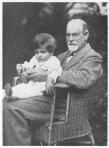
There is a curious passage in a recent book by Oliver Sacks, “Musicophilia: Tales of Music and the Brain,” in which Sacks discusses whether Sigmund Freud liked music.

There are contemporary accounts of Freud that mention he rarely listened to music, and only permitted himself to be “dragged” to opera on rare occasion – and then only if it was Mozart.  And there is a quote from a not-terribly-reliable memoir by Freud’s nephew, Harry, in which he claimed Freud “despised” music.

Freud wrote about his own response to music in the introduction to “The Moses of Michelangelo”:

I am no connoisseur in art…nevertheless, works of art do exercise a powerful effect on me, especially those of literature and sculpture, less often of painting…[I] spend a long time before them trying to apprehend them in my own way, i.e. to explain to myself what their effect is due to.  Wherever I cannot do this, as for instance with music, I am almost incapable of obtaining any pleasure.  Some rationalistic, or perhaps analytic, turn of mind in me rebels against being moved by a thing without knowing why I am thus affected and what it is that affects me.

This is a fascinating observation.  Freud is essentially saying that, because music is such an abstract art form and he cannot analyze the source of music’s effects upon his emotions, he doesn’t trust those effects and so avoids music as an art form.  That might explain why Freud wrote so seldom about music, although he wrote at length about works of fiction or theatre or painting or sculpture.

It is not the last word, however, on whether Freud actually enjoyed music.  His friend, Theodor Reik, wrote that he’d gone out to hear music on at least two occasions with Freud, and that it wasn’t only the mystery of music’s effects on the emotions that troubled Freud, but a fear of actually giving himself over to those mysterious effects. Reik felt that Freud’s resistance to music amounted to:

[a] turning-away…[an] act of will in the interest of self-defense…[and the] more energetic and violent, the more the emotional effects of music appeared undesirable to him.  He became more and more convinced that he had to keep his reason unclouded and his emotions in abeyance.  He developed an increasing reluctance to surrendering to the dark power of music.  Such an avoidance of the emotional effect of melodies can sometimes be seen in people who feel endangered by the intensity of their feelings.

What draws me to this discussion in Sacks’ book is that it reveals the “hidden” Freud, the struggle between the serious, scholarly author of countless books, the “father of psychoanalysis” – and the man who, like everyone else, was filled with secret, overwhelming emotions – perhaps triggered by something as innocent as a beautiful work of music – that he could only struggle to comprehend.

(more…)

Read Full Post »

The paperback version of my first book – Life is a Brief Opportunity for Joy
is now available on Amazon.com.

The terrific new cover is by Christine Sullivan, of cstudiodesign.  I hope you’ll take a look.

Read Full Post »

I get asked this all the time:  “What if it’s only chemical?”

Good question.  Why talk to a therapist if you can take a pill and be done with it?

Freud was intrigued by the possibility.  According to Peter Gay, in Freud’s late work, “Outline of Psychoanalysis:”

“[he] speculated that the time might come when chemical substances would alter balances in the mind and thus make psychoanalytic therapy, now the best available treatment for neuroses, quite obsolete.”

It’s appealing to treat mental illness as a chemical problem because chemistry seems clean and precise.  The fundamental functioning of the brain is both chemical and electrical, based on the difference in potentiality between sodium and potassium.  No problem.  You identify an imbalance, add ingredients, stir, and restore order.

But there is a problem.  The brain is also a ball of flesh, soaking in countless compounds we scarcely comprehend.

Injecting a drug – one more chemical – into your bloodstream is a primitive way to fine-tune complex chemistry.

That’s why psychiatric drugs are most effective when blunt, simple results are called for.  They can slow you down.  They can speed you up.  They can numb you or narrow your emotional bandwidth.  If you are bi-polar, they may help stabilize your emotional swings.  If you are psychotic, they may bring you back to reality, or at least closer to it.

For subtler changes in brain chemistry, talk therapy – or maybe talk therapy in tandem with a drug treatment component – produces better results.

How could talking in a therapist’s office affect the chemistry of the brain?

Your emotions are chemicals.  When you feel angry, your amygdala, a region in the center of your brain, releases a chemical signal.  That chemical – or series of chemicals, is what you experience as “anger.”  Joy, fear, sadness – all the emotions you feel as fundamental responses to the world around you – are chemicals.

Your thoughts are also chemicals.  When you admire a sunset, you are releasing chemicals which trigger electrical impulses that race through the circuitry of your brain.

Your thoughts affect your emotions.  So if I can affect  your thoughts, I can affect the chemicals triggering your feelings.

The brain is extremely mutable – neural pathways can be rerouted.  If I can make you aware of your thoughts and feelings, I can reroute the neurons in your brain, so different chemicals are released.

This isn’t as far-fetched as it sounds.  Here’s an example:  If you are depressed and I tell you to go for a run because it will cheer you up, I’m not merely nagging.  Aerobic exercise releases endorphins in your brain.  These chemicals cheer you up, relieving depression.

In the process, you will also create a memory – a piece of stored chemical information – that links depression with going for a run and feeling better.  A faint, newly formed neural link, and a piece of memory supporting that link, have been created.

Here’s another example:  if you are denying your anger – the typical pattern that creates depression – and I arrange during a session of psychotherapy for you to address your father, or your mother, or your boss or your girlfriend, and you feel anger well up and put that anger into words, saying what you’ve kept silent for years…that’s going to have effects on the chemistry of your brain.

When you get the words out, and feel your buried anger, new pathways will form between the ancient regions governing emotion in the center of the brain and more recently evolved cognition areas in the outer cortex.

New thoughts circulate new chemicals, create new memories, and effectively rewire the way you think.

You leave my office realizing you were angrier than you thought, and knowing it felt good to get it out.  You experience a lightening of mood.  Your girlfriend, when you get home, senses that you are less defended – your resistances are down.  This alters her behavior towards you, and she starts to open up to you emotionally to a new degree.  You begin questioning your old responses to her, and your old ways of doing things in general.

Your brain is flooded with new chemicals, and new pathways have been formed, that might, with further talk therapy, begin to replace old ones.

Subtle changes have been made to the chemistry of your brain – to who you are, how you think, and how you behave with others.

That’s what psychotherapy is all about:

Better living through chemistry.

=========

If you enjoyed this post, please check out The People’s Therapist’s new book.

Read Full Post »

One of my patients gets together sometimes for lunch with his ex.  It’s always awkward, he says, and a bit melancholy, but there’s something nice about it, too, and so it’s become a ritual.

This time she brought a piece of news – she’d met someone, and was getting married.

He was happy for her.  He knew that.  They’d been broken up for years, and were never really right together.  They’d dated for about seven months – she was the first person he’d seen after his wife died in a car accident.  Even when they were dating, he’d realized  she was probably too young for him and they had different interests and maybe he wasn’t ready and…well, it never really worked.

Yet, somehow, this news still hurt.

On the way home from the lunch he asked himself – Why?  Why does this hurt?

And then it came to him.

He pulled out his cellphone.

She was at her office, and seemed surprised.  He spoke to her frankly.

Listen,” he said. “I’m truly happy for you.  I mean that.”

“But…” she said, prompting him.

“But,” he hesitated.  “This sounds nuts, because we’re not together anymore, and we don’t want to be together anymore…but…I guess I just want to know I’m still your guy.”

He felt a little ridiculous, and wondered if she was going to hang up – but she didn’t.

“Oh, honey,” she said.  “Don’t worry.  You’re still my guy.  You’ll always be my guy.  That will never change.”

He felt tears welling up, and all he could think of to say was,”thanks.  I love you.”  And that was the call.

Now, in his session with me, he said he felt a little shaky, but okay.  It was as if she’d lifted a weight off his shoulders.  Their connection, whatever you wanted to call it, was still there after all this time.  Whatever she meant to him – and whatever he meant to her, still mattered.

Break ups are tough.  They are necessary sometimes, but they can leave you with a certain melancholy, an ambivalence.  There is always unfinished business in a relationship even when it’s run its course.

That was especially true for this guy because he’d lost his first wife suddenly, after only three years together.

“After my wife died,” he told me, “I vowed I’d never take for granted that I could talk to anyone whenever I wanted.  Of course, I’d give anything to talk to her again, but she’s not there.  So I talk things over with her in my mind – that’s all I’ve got.”

There are no easy answers when it comes to interacting with ex’s.  The relationship has run its course, and you both have a right to move on. Strong feelings may linger, and you might have to give each other some space.

That doesn’t mean you can’t be gentle.  Your ex is a person with whom you’ve invested a chunk of time – a person you have loved, who has loved you, and made you special in his life.  Some vestige of that bond is worth preserving, if you possibly can.

Of course, it’s toughest if the feelings remain strong.

One of my patients ran into her ex recently at a social function.  He told her he missed her, and she was surprised, when she looked in his eyes, to see an imploring look.  He meant it.  She knew, without asking, that he wanted to get back together, to give it another try.  But that was impossible.

It wasn’t that part of her didn’t want the same thing.  He was the one who had wanted to break up all those years ago, and she knew this was some kind of redemption – a chance to make him happy, and get that wish she’d clung to for so long.

But their time together was years ago – and she’d moved on.  She was in a new relationship.

She felt torn in two – one half in the past, wanting to give it another chance.  The other in the present, knowing it would never work.

And all along she was wondering if it was entirely in her head.  Maybe she was just reading something into his words, and his facial expression, that wasn’t there.

So they chatted about nothing, and then her ex turned to leave.  Nothing much was said.

She felt an ache for days afterward.

The next day she took out some old photos from their time together, and had a good cry.

She’d probably run into him again, one of these days.  And maybe he’ll have moved on, and maybe he’ll be in another relationship too, by then.

But there would still be that ache.

That’s the gift we receive for taking the risk of loving someone else.

Maybe he just wanted to know he was still her guy.

—————

Check out The People’s Therapist’s new book, “Life is a Brief Opportunity for Joy

Read Full Post »

It doesn’t make sense.  You hate depression, but feeling sad can be okay – and everyone loves the blues.

That’s because depression isn’t about feeling sad.  And the blues isn’t about depression.

Depression is about regressing into a child’s way of relating to the world.  You become helpless, so you lose touch with your own anger, your ability to protest against conditions that make you angry.  Instead, you accept defeat, and turn the blame, and the anger, in on yourself.

Sadness, on the other hand, is a recognition of impermanence.  It is about accepting that life is a brief opportunity for joy.

It is far from certain that impending death intensifies the experience of living.  If no one ever died, it seems like there would be less suffering and, if certain logistical details could be overcome, things might actually be more fun.

We’ll never know the answer to that conundrum.  You may lodge a protest, but life remains short, and only rushes by faster the older you get.

On the other hand, the natural human response to that set-up is to grab what’s there and enjoy it.  Sadness – the memory of impermanence – intensifies your hurry to drink deep of  good times.  In the process, every drop tastes sweeter.

The blues are songs written about sad subjects.  The levee is gonna break.  My woman done left me. That sort of thing.

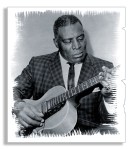
One of the saddest songs ever written is a blues song –  Son House’s “Death Letter Blues,” which begins like this:

I got a letter this mornin, how do you reckon it read?
It said, “Hurry, hurry, yeah, your love is dead.”

I could listen to “Death Letter Blues” forever.  It always makes me feel like cryin’.

But I always feel a little better afterward, too.

Why is that?

Because ol’ Sonny is sharing his pain with me.  And that feels good.  Makes us both feel better, or it did, back when Sonny was still kickin’.

Patients spend a lot of time in my office crying.  I once ran out of tissues – something a therapist should never do.  It was one of those panicky episodes, like running out of maple syrup at an IHOP.  People come to a therapist to cry.  I know I always did.

You come to have a good cry because it makes you feel better.  It feels good to open up and share the pain.

There’s another element to blues songs – the reason they’re not about depression.

The Blues fight back.  This is music that came up from African-American communities in the Deep South.  Those people knew oppression – heck, they knew human slavery.  But their souls were never dominated, even when their bodies might have been.

That’s the true history of the blues, and African-American music, period.  It’s subversive – it fights the power, stands up to the pain.  It stands up proudly.

The blues make good times from bad times.  They summon anger from fear and sadness, and in the process defeat depression.

The blues fight back by refusing to stay silent about the conditions the singer endures – poverty, loneliness and oppression.

Sometimes they fight back by refusing to lose their sense of humor. Check out Sonny Boy Williamson in “Fridgidaire Blues”:

No, but that’s alright mama, baby, I don’t like the way you do.
Well, but I been tryin’ two or three days, woman, you know, just to get rid of you.

There’s an obvious lesson here for beating depression.

Express your feelings someplace safe, and own your right to them.  You gotta right to sing the blues.

Don’t lose your ability to laugh at yourself, either.

Now – just in case you thought you didn’t care for the blues… here’s something sweet and lovely to tear up your soul:

Read Full Post »

At the end of Beyond the Pleasure Principle, there’s a moment where Sigmund Freud pauses to admit he’s gone out on a limb exploring his own ideas:

I do not know how far I believe in them…One may surely give oneself up to a line of thought, and follow it up as far as it leads…without, however, making a pact with the devil about it.

Hallelujah.  Not even Freud was a “strict Freudian.”

A new client showed up at my office a few weeks ago.  He said he was interviewing therapists.  His current therapist wasn’t working out, and he was going to several others to see if they were more what he needed.

I said sure.  And I sat Simon, my miniature wire-haired dachshund, in my lap and scratched his ears.

The patient stared at me.  I stared back.

“Would you like to hold Simon?”

It turned out this patient’s old therapist was very formal.  In fact, he wore a suit and tie and enforced strict rules.  Every session began the same way, with the therapist observing the patient in complete silence, waiting for him to begin.  This therapist would sooner wear a polka dot dress than have a fuzzy dog in his lap.  My patient admitted he found the whole set-up intimidating, like he’d been sent to the principal’s office.

I suppose there’s nothing wrong with doing things with a touch of formality – we all have our personal style.  The mistake is when you start to think your way of doing things is the only way.  That’s when you start making a pact with the devil.

Every patient needs a slightly different therapist.  That’s because every patient is a slightly different person.

I started out as a therapist using the couch.  My patients took off their shoes, lay down, and I sat on a chair behind their heads.  The idea was that they couldn’t see me, so they could free-associate without distraction.

Unfortunately, I didn’t have a proper psychotherapy couch – I had a sofa, with arms.

One patient was too tall.  His feet had to be propped up on the arm of the sofa.  It was an awkward arrangement.

At some point he looked up at me and said, “would it be okay if we just sat up and faced each other?”

I was going to start on a speech about how important the couch was to free association, but I didn’t have the heart for it. Maybe the couch wasn’t all that important.  One of the reasons Freud used the couch, or so it’s been said, is that he hated having his patients stare at him for hours.  Maybe it made him nervous.

We ended up sitting cross-legged on the floor for the final year we worked together – and we did just fine.

My point is that a lot of the details don’t matter that much in psychotherapy.

I know a therapist colleague who began wearing a formal suit and tie to sessions – until his patients told him to knock it off.

I used to wear khakis and button-down shirts during therapy.  It seemed formal enough, but not too formal.  At this point I’m typically in jeans and a polo shirt.  Last year I took a leap into the unknown and started wearing shorts.  It was summer, and hot, and my patients were all showing up in cut-offs and flip-flops.  Fair’s fair.

The art in your therapist’s office doesn’t matter much either.  I’ve moved paintings around and fiddled with the decor only to realize my patients never noticed or cared.

If there’s anything that does matter, above all else – it is that you loosen up with a therapist, and he loosen up with you, so you can both be yourselves and explore someplace new.

I’m a relaxed guy who likes to have my dog in my lap.

At this point, my patients usually sit in a chair, or flop down on the couch, or occasionally sit on the floor.  Whatever feels comfortable is okay with me.

The greatest danger in psychotherapy is when you stop realizing that it is an on-going experiment – an improvisation – and begin believing your own dogma.  That’s when you risk driving right off the rails into who knows where.

There was a time during the last century when reputable therapists actually used psychotherapy to try to “cure” homosexuals.  It is hard to fathom how a therapy that is all about awareness and acceptance of the authentic self could be misused in a more malicious and stupid way.  But they thought they knew what they were doing and they had a lot of fancy-sounding theoretical mumbo-jumbo and books by psychoanalysts with impressive-sounding names.  They had impressive degrees hanging on their walls, too.  I’m sure they were very formal and “strictly Freudian” about it – although every single aspect of their work violated the essence of Freud’s thinking.

A pact with the devil.

Freud was an explorer.  He accomplished breakthroughs in how we understand the human mind.  That’s because he took risks, and was ready to admit when he’d driven up a blind alley.  One of the interesting and for some, frustrating aspects of Freud is that there is no one book of his that contains all his ideas.  In fact, some of the ideas in later books contradict things he says in earlier books.  That’s because Freud made mistakes, and changed his mind, and never stopped exploring.

For a while, he thought cocaine was a wonder drug.  That didn’t last long.

Many of his theories came from explorations of his own psyche – “self-analysis.”  When that process worked, it was brilliant.  Freud was capable of feats of honesty about himself, honesty that brought shattering insights.  On the other hand, some of his ideas, like the “Oedipus Complex” probably tell us more about Freud’s family history than any generalizable theory of human nature.

Sometimes you have to lose your way to find yourself someplace new.  Never assume where you happen to end up is the only possible destination.

And don’t make a pact with the devil.  Reserve the right to change your mind.

For the record, Simon and I are strict Freudians.  Freud kept a dog in his office during sessions, too.  According to Peter Gay:

…Freud and a succession of chows, especially his Jo-Fi, were inseparable.  The dog would sit quietly at the foot of the couch during the analytic hour.

Far be it from me to betray strict Freudian doctrine by performing dog-less psychotherapy!

Add to FacebookAdd to DiggAdd to Del.icio.usAdd to StumbleuponAdd to RedditAdd to BlinklistAdd to TwitterAdd to TechnoratiAdd to Yahoo BuzzAdd to Newsvine

Read Full Post »

Albert Einstein was puzzled by the mystery of his own fame.  He was forever pondering with friends and associates why he – a physicist whose work was a mystery to most non-scientists – should have become the recipient of full-blown Hollywood-style celebrity.  For whatever reason, Einstein chose not to discuss this issue with the father of psychoanalysis, Sigmund Freud, either when they met in person in 1927, or in their later correspondence.  As one of Einstein’s biographers, Denis Brian, put it:

Einstein…missed the chance for a Freudian explanation of why hordes of people incapable of understanding his ideas threated the quiet contemplation he craved to pursue his work by chasing after him.  Are they crazy or am I?  he wondered.

I suspect Einstein never asked Freud why people hounded him as a celebrity because it seemed a silly and self-indulgent question.  Most of Freud and Einstein’s correspondence concerned serious politics – the Nazi threat, Zionism and the like.  It was also a pretty obvious question.  People flocked to Einstein for the same reason they flock to any celebrity – because they want to be that celebrity. Wouldn’t it be wonderful to be Einstein – by popular acclaim, the smartest person in the world – and have everyone associate your name with the very definition of genius?

Einstein might have been loathe to admit it, but he was rich and famous – and we all want to be rich and famous.  In fact, if you were asked what you wanted to be right now, more than anything else – and you didn’t stop to reflect – you might just answer “rich and famous.”

Why?  Because that’s what most people assume they want, until they stop and think, and maybe come up with an answer that’s a little more meaningful.

Even if they do stop and think about it, they still might want wealth and fame, without realizing it – like Einstein.

No one was more consciously self-effacing or less interested in money than Albert Einstein.  He was constantly reminding people that he was only one of many talented physicists, including many great predecessors who laid the groundwork for his theories.  He was also fiercely determined to live unostentatiously – giving much of his money away and using a good deal of it to help others, including fellow Jews who needed to be sponsored financially in order to escape Nazi persecution.

Deep down, though, Einstein sensed something was going on with his relationship to fame and fortune.  As Brian puts it:

Einstein half-seriously speculated that he himself was to blame;  that elements in his makeup of the charlatan, the hypnotist, or even the clown inadvertently attracted attention….He suspected that he might unconsciously be inviting the hunt…

Well, of course he was inviting the hunt.  That’s because, while Einstein’s adult self disdained wealth and fame, his child, given the chance, drank it up.

Your child craves it, too.

To understand why, let’s take a look at what “rich and famous” really means.

Rich means loved.  Famous means paid attention to.  The same things you have craved since the day you were born.

Money, in psychotherapy terms, is a surrogate for security in love.  A patient once told me if he won the lottery he would build a brick house that needed no maintenance and would stand for five hundred years, then he’d create a fund to guarantee that the taxes and every other possible expense would be paid for in perpetuity.  He’d have a place, a safe place, forever, that no one could ever take away.  He could finally feel safe and breathe free.

Of course, that’s a dream.  First, because you’re going to die, eventually, even if you’re hiding inside a brick house.  And second, because sitting alone in a house isn’t a satisfying way to spend your life.  Feeling secure boils down to more than money or a big house – it’s about feeling safe in someone’s affection, and it starts with learning to love yourself.

As a child, you can gauge your parents’ investment in you – their love – by whether they are paying attention.  You learn to do everything you can to keep their eyes on you as much as possible – like a kid at the playground, calling to his mother, making sure she watches each and every trick he performs on the jungle gym.  Attention is like food for a young child.

There’s evolutionary history behind our desire to be rich and famous.  It traces back to the fact that humans, with their gigantic brains, take a long time to reach maturity. An orangutan reaches adolescence at about age four.  He’s in contact with his mother’s skin almost without break for much of that time, then soon becomes independent.  A human doesn’t reach adolescence until thirteen.  He requires more than a decade of childcare – too many years to rely solely on the care of parents.  The human child senses instinctively that his life might depend upon summoning care and attention from others.

No wonder you work hard to become rich and famous.

The problem with chasing wealth and fame is that it’s a child’s mission, not an adult’s.  At some point you must step out of childhood – that long, helpless period of your life – and move onto the independence of maturity.  Instead of needing reassurance that you are loved, you can achieve independence by learning to love yourself.  That big step into adulthood is an affirmation that you deserve love, and deserve to receive it from those you call friends or partners.

You needn’t crave attention as an adult, either.  It feels nice, now and then, to receive praise for your work.  But if you have your own attention – you’ve done the job of living consciously as your best self and winning your own respect – you no longer have to cry for mommy to watch you perform on the jungle gym.  You can learn to feel safe and secure in your own abilities and achievements.

Security within yourself is worth more than being rich and famous.  The ultimate goal is security in the knowledge that you have friends who deserve you and care about you, meaningful work that you enjoy and a partner who is a true friend and ally.

That beats wealth and fame any day.

It’s interesting that one of the most famous photos of Albert Einstein features him sticking his tongue out.  You’ve probably seen it a million times on postcards or posters on dorm room walls.  It seems to speak volumes about Einstein’s naturalness and lack of pretension – his being in touch with his child. Perhaps that’s true.  It was photos like that – and his crazy hairdo – that helped make Einstein an icon of approachable, lovable brilliance.

On the other hand, that photo, which was taken in December 1948, captures Einstein shortly after he was operated on at Brooklyn Jewish Hospital for a large and potentially life-threatening aneurysm of the abdominal aorta.  Brian describes the circumstances of the photo:

After overhearing a doctor say that the hospital was short of private rooms, Einstein insisted he was “getting much better” and asked to be moved to the ward.  That way, his room could go to someone who needed it more.  He was talked out of it when told he would be more trouble in the ward.  Helen Dukas [his private secretary] came to collect him a few days later, and they left by the back entrance through a gauntlet of reporters, newsreel cameramen, and almost the entire hospital staff, who were there to wish him well.  On the way home, pestered by photographers, he was snapped by one of them, sticking his tongue out at him.
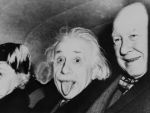
The original, un-cropped version of the photo gives a slightly different impression from the familiar cropped version.  The original includes the people around Einstein, who are trying to hurry a sick man home through a crowd of reporters.  Perhaps, when he stuck out his tongue, Einstein the adult was simply annoyed and exasperated at a mob harassing an aging, unwell physicist whose work none of them could even understand.

On the other hand, maybe Einstein’s child was having a bit of fun and enjoying the attention.

Probably both were true.  Einstein might not have been certain himself of exactly how he was feeling at that moment, or why. But however much he unconsciously basked in the glow of wealth and fame – or fled from it – the father of relativity devoted the majority of his later life to ignoring his wealth and avoiding attention while working hard to achieve nuclear disarmament and world peace.  Being rich and famous wasn’t enough.  Einstein the adult needed a more meaningful dream.

Add to FacebookAdd to DiggAdd to Del.icio.usAdd to StumbleuponAdd to RedditAdd to BlinklistAdd to TwitterAdd to TechnoratiAdd to Yahoo BuzzAdd to Newsvine

Read Full Post »

My patient was in a tizzy about a relationship:

“I don’t know if I can do this.  I mean – he’s talking about going on a vacation together.  What if we break up before then?”

I tried to calm her down.

“You guys have been dating for a month.  No one’s bought tickets.  He’s just talking.  And you two seemed to be having fun together.”

“But I don’t want to hurt his feelings.  Maybe I should break up with him now, before he gets too into me.”

“You barely know each other.  Give it a chance.”

“But what if I want to date someone else?  Wouldn’t that be cheating?”

“After a month?  It’s too soon for commitment.  Try to relax and have some fun.”

I encounter this type of anxiety in my patients all the time.  Relationships are scary because people make them scary.  Even during the first few weeks, they build up the pressure until they’re going nuts, then complain that they feel smothered, walled-in, overwhelmed, suffocated – it doesn’t make any sense.

When you climb a ladder, you shouldn’t look down because you’ll get scared.  The trick is to ignore how high you’re getting, and keep climbing.  At some point it doesn’t really matter how high you are – you’re high enough that if you fell, it would be bad.  So why bother looking and get freaked out – just keep climbing.

It’s the same with relationships.  Don’t look too far ahead or you’ll panic.  Try to relax, keep going, and have fun.  If you pay too much attention to how many weeks, or months, or even years have gone by, it will only spook you.  Take it day by day, moment by moment.  How long a relationship has been running doesn’t tell you anything about its quality in the moment, where it’s actually playing out.  Maybe you’ve been together 60 days or 60 years. They both probably seem like a long time, depending on where you are in your life.  The more important question is are you happy together right now?

The past is behind you and the future is unknown.  The present is where you live.  That’s where relationships take place.  The key question each day is:  am I having fun?  Do I want to continue to share experience with this person?

If the answer is yes, keep going.  If not, maybe wait a little while longer, and if the answer is still no – it might be time to move on.

I’m amazed at how quickly my patients begin to feel overwhelmed by relationships.  That happens because they rush things – stare out at the distant horizon instead of staying in the moment and concentrating on today, the time you’re sharing right now with another person.

Remember, it’s easy to break up.  It takes about two minutes.  Say “this isn’t working for me” and walk away.  Done.  You can end a relationship in the time it takes to brush your teeth.  No one is “trapped” in a relationship.

Starting a relationship is the time-consuming part:  meeting someone, connecting, finding out about one another and keeping it going.

The road ahead in every relationship is unknown.  And it doesn’t really matter all that much because you can’t control the future.

I’ve developed a few general time guidelines for relationships, just from watching my clients and seeing what works.  I think four months of dating is a symbolic milestone.  That’s the first time it would be remotely sensible to consider whatever you two have more than casual dating, and maybe even contemplate the idea of becoming exclusive.  I don’t know why I chose four months – maybe the idea of sharing an entire season of the year is symbolic.  You’ve gone one quarter of the way around the sun in one another’s company, from equinox to solstice (or vice versa.)

Six or eight months seems like a reasonable time before you consider yourselves a couple and present yourselves as such.  A year or 18 months seems like a reasonable amount of time before you think about moving in together.

These are not hard figures – everyone has their own way of doing things.  But if you’re going much faster than that, you’re probably rushing things – trying to get to the end of the road instead of letting things unfold organically, and stopping to enjoy the ride.

There’s no rush to get “established” in a relationship.  A relationship never has to be anything other than a choice you’re making because you’re enjoying it – something you want to do, today, for yourself.

Anyone who’s in a really good long-term relationship will tell you:  it’s best when every day feels like the first day, when you first met someone interesting and thought – hey, this is fun.

Read Full Post »

My patient was clearly miserable in her job as a graduate student and laboratory scientist.  But she’d worked very hard to get into this position.  And she was only 3 years away from a PhD.

“I don’t know what’s wrong with me,” she said.  “I’m just not good enough, I guess.”

She was blaming herself for this career not working out.  I suggested an alternative.

Instead of viewing a job as a task, consider it is a role.  Not a thing, but a person.

It wasn’t that she couldn’t do this job – it was that the job didn’t represent her authentic self.  She wasn’t a laboratory scientist.

Initially, as a teenager, your career dreams hit a cruel reality when you discover that your talents and aptitudes are limited by nature, not by choice.  You probably had all the commitment it took to be a rock star…but none of the talent.

That’s a harsh, if commonplace realization.  You tend – especially as an adolescent – to imagine yourself as the protagonist in a heroic narrative, and it can be crushing to realize you are limited by banal realities like being too short to be a basketball star, or singing too out of tune to be the next Beyonce.

Once this life lesson is learned, though, you think you’ve found your groove.  You’ll just find something you’re good at, and do it.

Unfortunately, that’s when you hit yet another realization.

Even if you have the talent and aptitude for a certain job – you also have to “be” that job.  It has to represent who you are.

That’s why you have to know who you are before you can know what you want to do.

Think about work for a moment, and how it came into being.  Originally, when all humans were primitive hunter-gatherers, the break-down of labor must have been rather simple.  Mostly likely the men went hunting out in the field and the women took care of the kids and whatever other tasks could be handled close to the settlement area.

With the arrival of agriculture and domesticated livestock – and much greater population densities – greater specialization arrived.  The Middle Ages in Europe saw the rise of guilds – early unions for skilled laborers.  There was also more leisure time – at least for the wealthy classes – so artists and musicians began to appear.  A king or a duke might hire you simply to set gemstones on snuff boxes, so he could hand them out as keepsakes.

You can view this development in one of two ways – that there was a need for lavish snuffboxes and someone had to be found to make them – or sightly differently:  there was someone out there who had the idea and the inclination to make lavish snuffboxes, and he finally found his opportunity to follow a dream.

I think the second explanation makes more sense.  As roles in society became more specialized, people were more able to express who they were by finding a niche where they fit in.  Each “job” or “career” was really someone finding an outlet to express himself.

The real question, then, isn’t how you can find something you can do.  It’s who are you, and what is the job that reflects your authentic identity.

Years ago I spent a weekend at the home of a very wealthy man, the father of a friend from school.  This guy was a genuine titan of business – he sat on the board of a federal reserve bank and went fly-fishing with Paul Volcker.  He was a terrific guy and a wonderful host, and the first thing I noticed about him was that he loved to play games – board games, card games, any games.  The second thing I noticed was that he always won. Always.  Each and every time.  By a wide margin.

Clearly, there is a link between success in business and aptitude at games.  That is demonstrably true – Bill Gates and Warren Buffett are both expert poker players and so are dozens of other zillionaires.

But some people who are good at games simply become gaming enthusiasts, or mathematicians or computer scientists.  To become a titan of the business world, you have to be a titan of the business world.  It has to be who you are.

The quickest way to figure out if a career fits who you are is to go to the lunchroom where you work, or some other forum where a bunch of other people with that career are gathered, and ask yourself if you fit in with this crowd.  Now – of course – you could always decide to do things your own way – be that renegade accountant who doesn’t ride with the pack.  But, as a general rule, if you stick out like a sore thumb in the lunchroom, it might be a good indication that you don’t belong in this crowd – and this job doesn’t represent the essence of  who you are.

Sometimes we run from the truth of who we are.  My graduate student patient had ended up studying science mostly because it was practical.  She was an immigrant from China, and pretty good at math and science, and she needed something practical, that could get her to the United States, but didn’t require perfect English skills.

Deep in her heart, she confessed to me later, she longed to be a writer – a journalist.  That might be a lot tougher to arrange – but ultimately, it was her happiness at stake, and we both concluded she’d be better off struggling to be true to herself than continuing to pursue a career that felt false and unsatisfying.

I once worked with a man who was preparing to take the MCAT exam to enter medical school.  He, too, had the aptitude to be a doctor.  But deep in his heart, he confessed to me, he longed to be a hair-dresser.

My opinion was that the world needed an inspired hair-dresser more than it needed an uninspired doctor.

You might think you need to choose something practical for a career.  But at some point, you realize a career isn’t about what you choose – it’s about who you are.  It chooses you as much as you choose it.

I had a patient who went to law school and struggled to make a career as a corporate attorney, but he was miserable.  The odd thing was that his entire family worked as teachers.  I finally asked him why he hadn’t become a teacher like everyone else.  He thought about it and said he’d wanted to be different.  Being a teacher seemed like giving up and admitting he was like everyone else in his family.

Eventually, he ended up quitting law anyway, and – sure enough – pursuing teaching.  But he found his own way to be a teacher. In so doing, he found a way to be himself.

Add to FacebookAdd to DiggAdd to Del.icio.usAdd to StumbleuponAdd to RedditAdd to BlinklistAdd to TwitterAdd to TechnoratiAdd to Yahoo BuzzAdd to Newsvine

Read Full Post »

A lot of people thought Ludwig van Beethoven was an unpleasant person.

He could be impatient, and often tempestuous.  But most of the time, when people thought the composer was being gruff or imperious or rude, it was the result of his trying to hide the fact that he couldn’t hear a word they were saying.  For many of the final years of his life, Beethoven was stone deaf.

Here’s how he explained the situation in a letter:

Forgive me when you see me draw back when I would have gladly mingled with you. My misfortune is doubly painful to me because I am bound to be misunderstood; for me there can be no relaxation with my fellow men, no refined conversations, no mutual exchange of ideas. I must live almost alone, like one who has been banished; I can mix with society only as much as true necessity demands. If I approach near to people a hot terror seizes upon me, and I fear being exposed to the danger that my condition might be noticed.

It would  have been embarrassing, and jeopardizing to his career, if anyone other than Beethoven’s closest confidants discovered his deafness.  So he did his best to hide it, and in so doing often appeared rude.

Many of the people who encountered Beethoven assumed he didn’t like them, or was simply a snob – in other words, that it was all about them.  But it had nothing to do with them.  It was about Beethoven.

My point is that mind-reading is impossible.  You will never know what someone else is thinking – what’s really going on in his head – unless you ask him, and listen closely to his answer.

I often watch patients react badly to something a friend has said or done, operating on the assumption that they knew what their friend was thinking…only to be proven wrong.  That’s how misunderstandings occur.

Sometimes you don’t even know what you’re feeling.  Maybe that’s why Beethoven felt driven to write music, even to his last breath, when he could only hear it in his head.

If you want to know what Beethoven was really thinking and feeling, listen to a little of this – music written in the mind of a deaf man:

Beethoven wasn’t the only misunderstood musician.  John Coltrane was often described as a very serious man who never smiled.  In reality, he was a sweetheart – just self-conscious about his crooked teeth.

Here’s what Coltrane was really thinking:

Miles Davis, too, was accused of being hostile and aggressive because he sometimes turned his back to the audience during performances.  In reality, he was conducting.  At that point in his career, Miles was playing very sophisticated, partially improvised music. He’d created an involved, customized system of hand signals with his band, and needed to pay attention in order to give them complex musical cues.

Here’s what Miles was really thinking:

People are complicated.  Some of them – like Beethoven, or Coltrane, or Miles – you could spend a lifetime figuring out.

The first step is to stop trying to mind-read, and understand it might not be about you.  It might be about them – and understanding who they are before you jump to conclusions.

Add to FacebookAdd to DiggAdd to Del.icio.usAdd to StumbleuponAdd to RedditAdd to BlinklistAdd to TwitterAdd to TechnoratiAdd to Yahoo BuzzAdd to Newsvine

Read Full Post »

I am happy to admit I do not know what lies at the farthest reaches of outer space, I do not know what happens after I die, and I do not know how long my relationship with my partner will last.

No one knows these things.  They are unknowable.

You might feel uncomfortable with these sorts of unknowns.  Uncertainty might make you anxious.  Infinity without end, your own mortality and the prospect of breaking up are scary – they challenge your sense of stability.  The child inside you still craves stability, even if the adult accepts it is only an illusion.

For better or worse, nothing is more common in this world than infinity, decay and entropy.  They are the building blocks of a universe that consists largely of vast stretches of emptiness with, here and there, some dust floating around.

A good parent behaves a bit like a con man, tricking a child into accepting a made-up world unreflective of the universe around him.  A child’s ideal world is a fantasy – small, secure and numbingly repetitious.  He goes to sleep at the same time every day and wakes up at the same time every day.  Meals are always the same, and at the same time, too.  Friendly imaginary characters like muppets and  cuddly purple dinosaurs are provided to reassure him things are okay.

As an adult, that type of environment would feel stifling.  Leaving things unknown – and occasionally surprising – can be more fun.  In part, that means accepting that expectations drawn from the reality of our daily lives might not be generalizable to the world as a whole.

For example, we live out our lives stuck to a round ball of rock by a mysterious force known as gravity.  If we keep traveling in any direction, we end up back where we began.  Just like your childhood neighborhood, that reality might feel safe and normal.  But simply because the Earth is designed that way doesn’t mean the universe is – space may well continue on forever.  Yes – without end.  Forever.

Same thing with death.  As a child, you got used to waking up each day and seeing the same friendly faces.  But as you get older you realize that situation isn’t permanent – people die, and you will too.

You can cling to the familiar childhood notion of waking up and starting a new day each morning by adopting primitive imaginary belief systems like reincarnation, or a heavenly paradise.  You can reproduce the familiar trope of a loving family with a strong parent figure through the invention of a god or goddess or a whole pantheon of imaginary deities.  These comforting, commonplace notions might permit you to evade the concept of a permanent ending for your life.

It’s more satisfying, and more fun, I think, to admit you don’t know what happens next.

One of my fond memories of attending Harvard University was studying with Stephen Jay Gould, the brilliant paleontologist.  Gould’s specialty was blowing his students’ minds by reminding them that their assumptions might not be generalizable to every situation.  He gave a lecture on how things would look if you were only a quarter inch – or 40 feet – tall.  My assumption – like a child’s – was that things would be pretty much the way they are now, except I’d be smaller or I’d be larger – essentially I’d be looking up at stuff or gazing down at it, but that would be that.

Gould explained that at 1/4 inch tall, gravity would no longer be an issue – you could probably jump from a great height and ride the breeze…but you might get your foot trapped in the surface tension of a puddle.

At 40 feet tall, your bones would be unable to support your body weight, which would be measurable in tons, and you would instantly collapse from the effect of gravity upon your mass.  You would be well-advised to take to the seas, like a blue whale, in order to survive.

Things look different, depending on circumstances.  As an adult, they are far more complex – and interesting – than they were when you were very young.

As a child, relationships were supposed to last forever.  Mommy and Daddy – the two relationships that mattered above all else – were necessary for your survival, and you took it as a matter of faith that they had to be there or you would perish.

But as an adult, you begin to understand that the universe might have no end, that all life must draw to a close – and that a partner is only a companion for as long as you – and he – decide to stay together.

An adult’s world needn’t be child-proofed.  It can be a bracing – and liberating – experience to see things as they really are instead of how we expect or wish them to be.

Add to FacebookAdd to DiggAdd to Del.icio.usAdd to StumbleuponAdd to RedditAdd to BlinklistAdd to TwitterAdd to TechnoratiAdd to Yahoo BuzzAdd to Newsvine

Read Full Post »

« Newer Posts - Older Posts »