
When Sarah asked me to put this together, my first thought was, well…let’s not just have me lecturing with slides, not at a time like this. So instead I talked her into doing a sort of conversation, along with me. And that was a relief. Because sure, therapists can dispense advice, and occasionally I might even stumble on a good piece of advice. But what therapists mostly do best is give people a chance to talk to someone who really wants to listen and cares about what you’re saying, so you can hear yourself, and we can both heal one another.
These are scary times we’re living through. You can reality-test your fears and you might find this time that no, you’re not just being neurotic, these times really are scary. During days like these, we need one another more than ever, and this webinar was a way of acknowledging that, and bringing a bit of healing to all involved. Hope you like it. And wishing you the very best as we all navigate this pandemic together. It will end.
===============================================================

Please check out The People’s Therapist’s legendary best-seller about the sad state of the legal profession: Way Worse Than Being a Dentist: The Lawyer’s Quest for Meaning

And now there’s a Sequel: Still Way Worse Than Being a Dentist: (The Sequel)

My first book is an unusual (and useful) introduction to the concepts underlying psychotherapy:Life is a Brief Opportunity for Joy

I’ve also written a comic novel about a psychotherapist who falls in love with a blue alien from outer space. I guarantee pure reading pleasure: Bad Therapist: A Romance



 The larger issue we chewed on is that every therapist, by necessity, is a generalist – it comes with the territory. People are complicated, and diverse, and labels, while useful in some contexts, tend to blur important distinctions in others. We’re all a lot like everyone else – and completely unique, as well.
 Please check out The People’s Therapist’s legendary best-seller about the sad state of the legal profession:


 Before I was a psychotherapist, I was a patient, and at some point in my time as a patient, I participated in group therapy, and witnessed an unsettling interaction. (Unsettling-interaction-witnessing occurs in groups, where you spend time watching people “work their stuff out” and often “work your stuff out” at the same time.)
 We all know lawyers are pleasers. Everyone knows that. The weird thing is how it doesn’t feel that way from the inside. When you are a lawyer, and a pleaser, you don’t think you’re a pleaser – it seems more like you’re the only conscientious person in the world. You are the one who shows up on time, sits in the first row and hands your homework in on schedule, always perfect. Other people don’t, and that’s annoying. Thus begins a typical lawyer pet peeve – that other people never live up to their obligations. Stretch that out to the extreme, and you wind up doing a job where you bill 3,000 hours a year, just to set a good example for everyone else.
 Blue’s Clues was a children’s television program developed in the 1990’s with the cooperation of child psychologists. The show was unique because it sought to incorporate the findings of cognitive psychology research on children into its content and presentation – a goal that produced surprising results.
 I was delighted to be included as a contributor to a piece on Law360 last week – entitled “How to De-Stress and Find Balance as a Busy Lawyer.” My sense is that my views positioned me as somewhat of an outlier among the other contributors…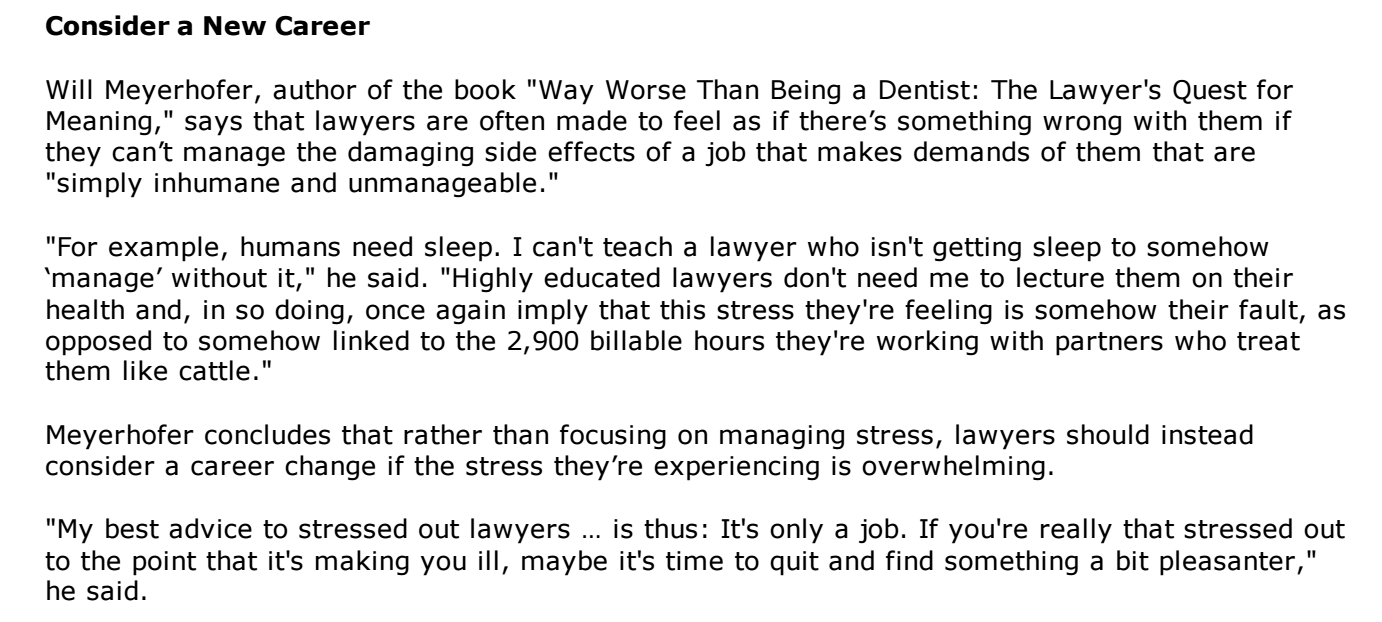
 Congratulations, you’ve “gained admission” to a lower-tier law school! You might be wondering what the actual experience is going to be like. Well, if you’re one of those lucky souls who’s had the unique pleasure of matriculating at Trump University, you’re at a big advantage, because lower-tier law schools and Trump University are a whole lot alike. Let’s count the ways:
 The People’s Therapist just got profiled in The Financial Times (with a couple other therapists.)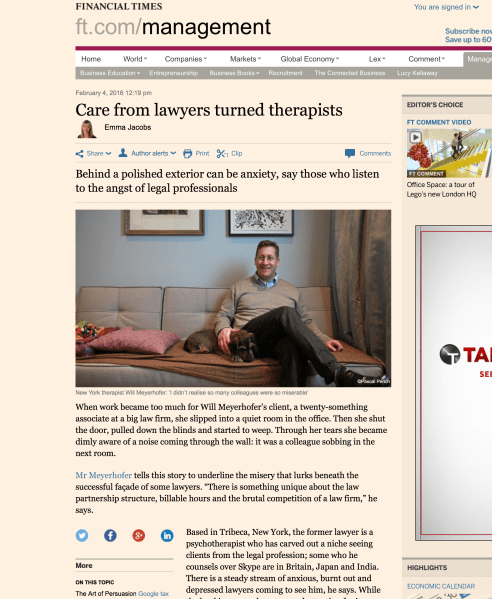
 Mike DeBlis is an exhilarating interviewer. After chatting away merrily for nearly an hour, delving down into the issues in a refreshingly honest and unvarnished manner, he surprised me by nonchalantly announcing: “Will, this is great.” I, of course, enthusiastically agreed. Then he added, even more nonchalantly, “So, shall we begin recording?” I couldn’t think of anything else to say, but “sure.” And so we did.
 I realized that’s the secret to how Mike gets such open, authentic, natural sounding podcasts for his series – he uses that first hour as the warm-up, to actually sit down and talk and talk and get to know his guests.
 Bet you didn’t even realize you were such a nervous wreck!
 My thanks to the lovely and talented Stephanie Francis Ward, and the ABA Journal, and her producer, Larry Colletti, for their help with this project. For more information on Stephanie and her journalism, click
  You’ll be delighted to hear that my Bloomsday-honoring webinar with
 The People's Therapist