 A patient was complaining about dating.
“It’s annoying. You have to be cheerful and upbeat. What if you’re not feeling it?”
I asked him how he really felt.
“Don’t even go there. I hate people. All they ever do is take.”
He wanted to meet a girl with whom he could actually bond, and get close. But it seemed impossible. He was looking online – it was easier, and that way he didn’t have to actually go out into the world and deal with humanity.
“What’s your online profile like?”
“The usual – just a regular guy who likes to go out for dinner and take walks in the park, blah blah blah.”
“Is that really you?”
He shrugged. “Is that really anybody?”
“So there’s your mistake. You’re not introducing yourself as you really are.”
“Who would want me as I really am?”
“You’d be surprised.”
Your first instinct, when you post a dating profile online, might be to do what everyone else does – lie. But that doesn’t help you achieve your goal of meeting an appropriate partner, it hinders it.
Many years ago, when I was single, I fell into the same trap myself – I typed up a bland, predictable online dating profile that made me out to be pretty much like everyone else. Then, at some point out of boredom or sheer frustration, I decided as an experiment to post a profile that told the truth. The result sounded something like this:
I’m Probably Not For You
I am not a “regular guy” and I won’t be right for most people reading this. I’m a bit intellectual and if you aren’t a bit intellectual too and don’t read all the time and love classical music and jazz it isn’t going to work. My perfect night out is vegetarian food followed by a classical piano recital at Carnegie Hall followed by listening to some guy play saxophone in a jazz club. I eschew discotheques and bars and don’t really “get” Madonna or Broadway. Oh, and I’m a raging atheist, a partisan Democrat, hate smoking and cars and suburban sprawl and have strong opinions across the board on most things. I kiss my dog on the lips. If this sounds right and you like my picture, go for it.
Instead of the occasional bland note I’d been receiving with my old profile, I was suddenly deluged by interested parties writing me long, detailed letters. And all I did was tell the truth.
It works with simple stuff, like sex, too. I worked with an African-American gay guy a while back who told me he had no luck with online ads on dating sites. I asked him what he was advertising for, and he said – oh, the usual – “versatile guy looking for fun.”
Then I asked him what he really wanted.
“Oh, a big daddy to top me all night.”
“Then why don’t you ask for what you want?”
“Oh, no one wants a big bottom…”
“No harm in trying.”
He posted a profile advertising (more or less) “Hungry super-bottom for fierce daddy top.”
That did the trick, so to speak. He had more offers than he could handle.
Gay or straight, or in-between, if you tell the truth – at very least, about sex – someone might be looking for what you’ve got to offer. I’ve had clients with interests in kink, or who liked to be submissive in bed – or to dominate – and nothing works better than just coming out and saying it. You can bet someone else shares your interests, or has an interest in accommodating it, but you’ll never find out unless you take the first step and tell the truth. If you want to smear her body with whipped cream, then lick it all off (or have someone do that to you) then say so! (And yes, that might entail first finding a dating site that specializing people into whipped cream, but if you look, it’s probably out there.)
In broad terms, truth-telling – direct, honest communication – is always a good first step towards establishing a healthy relationship. I’m frequently asked the question: “How can I tell someone else something difficult about myself?” My answer is always the same: directly and honestly. When you stop and think about it, isn’t the definition of a best friend “the person you can say anything to”? And that goes especially for talking about the most personal stuff of all – the stuff about yourself. A romantic partner is supposed to be your best friend, the person who can know you – and accept you – as you really are.
Forthright communication regarding who you are means you stop apologizing for yourself, and own that you are in charge of your identity, and decide who you want to be, living as best you can the life you’ve been given. That’s the very definition of charisma – feeling comfortable in your own skin.
 Sometimes you might feel the urge to hide stuff you’re afraid no one can accept, as if you’ve forgotten you’re not alone in being human. I had another gay client who was 69 years old and HIV+. He wanted to date online, but was terrified to reveal the truth about his age or his HIV status. Instead, he ran a profile with no photo or details, and lied about how old he was. Predictably, no one answered, and he was crushed.
I suggested he bite the bullet and tell the truth. It took weeks to bring him around, but finally he put up a pic (he was actually a good-looking guy) and revealed both his age and status. Lo and behold! Dozens of gay men in their 60’s and 70’s started coming out of the woodwork, many of them also HIV+. It only took one person with the courage to stand up and stop apologizing for the reality of his life, and everyone else followed.
Back to that first client. We talked about possible approaches to his “truthful” profile, and came up with something along these lines: (more…)
 A life-long dream has at last come true. I’ve been profiled…in French! Oui! Little ol’ moi has made it into the pages of French Canada’s most prestigieux publication for lawyers, Droit-inc!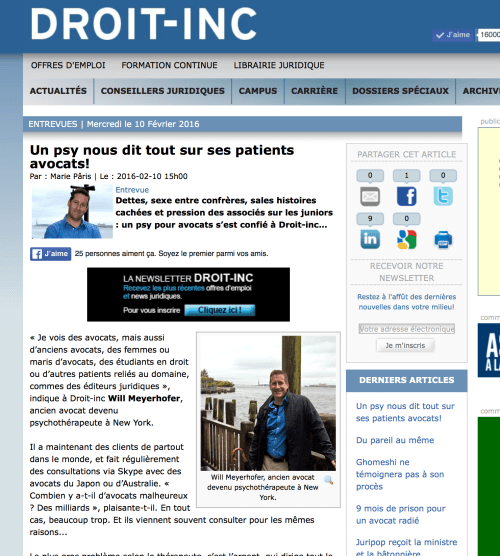
 Please check out The People’s Therapist’s legendary best-seller about the sad state of the legal profession:


 My first book is an unusual (and useful) introduction to the concepts underlying psychotherapy:


 The People’s Therapist just got profiled in The Financial Times (with a couple other therapists.)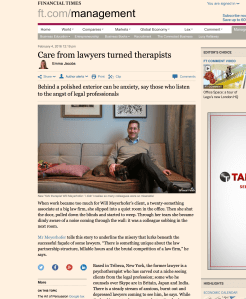

 This one really happened – and it happened to yours truly (as opposed to the usual disguised anecdote loosely based on a factually altered tale from one or more carefully anonymized clients.)
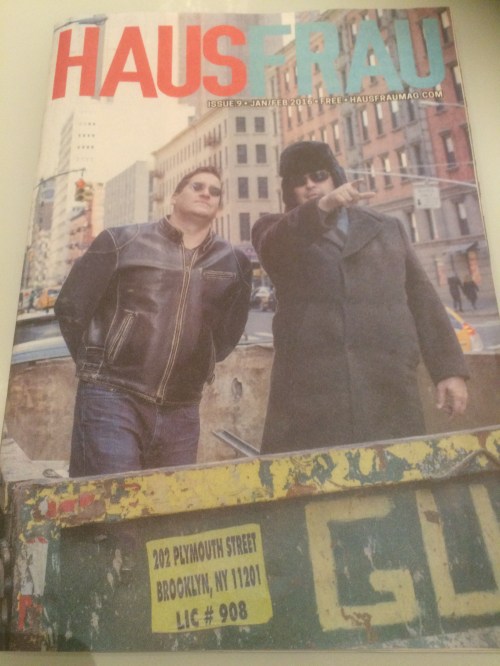 If, like everyone else, you’re an obsessive fan of the legendary underground humor magazine, Hausfrau, then you were perhaps extra-psyched this week when the latest issue, #9, was released and guess who was on the cover, in the guise of my alter ego, psychoanalyst extraordinaire “Franz Woyzeck,” accompanied by a celebrity known only by a single name, the notorious “Pico” (a.k.a. Anthony Gallegos.)
 I was bracing myself for a session with this client. She was in a tough spot, and my job wasn’t easy – letting her vent, offering some support and, in essence, trying to counteract the toxic atmosphere of her big-city law firm.
 I’m always hearing that I’m a downer, that all I ever write about is the negative side of law. Nothing could be further from the truth. If The People’s Therapist has one precept he lives by, it’s that old adage (okay, so maybe it’s a tenet) from management theory: Don’t bring me a problem unless you’re also bringing me a solution. It’s hardly my issue that all people ever seem to bring me (at least where law’s concerned) is problems. I’m drowning in their problems, and they must have the wrong guy, because I’m a constitutionally upbeat, constructive person – all about solutions, and upbeat ones, at that. Upbeat, constructive solutions are my forte. But these law people…what can I say? They just keep coming with the problems.
 We all know the holidays can be tough – all that socializing amid eggnog and tinsel and mistletoe can generate stress and result in those awkward holiday party moments…which can get kind of…awkward.
 You are sooooo in luck this holiday season, because the ever-delightful Gina Vivinetto, of Today.com, just interviewed me (as well as a couple other highly qualified expert advice-giver types) and, in her inimitable fashion, extracted every delicious holiday morsel of holiday party wisdom we could summon from the deepest recesses of what remains of our holiday party addled minds.
 The tantalizing results are now published and available for your eager holiday partying perusal. The article, entitled:
 Mike DeBlis is an exhilarating interviewer. After chatting away merrily for nearly an hour, delving down into the issues in a refreshingly honest and unvarnished manner, he surprised me by nonchalantly announcing: “Will, this is great.” I, of course, enthusiastically agreed. Then he added, even more nonchalantly, “So, shall we begin recording?” I couldn’t think of anything else to say, but “sure.” And so we did.
 I realized that’s the secret to how Mike gets such open, authentic, natural sounding podcasts for his series – he uses that first hour as the warm-up, to actually sit down and talk and talk and get to know his guests.
 There’s no escaping CLE – so why not make it fun, with The People’s Therapist! I’ve just finished helping to create an hour-long CLE On-Demand course concerning law and mental health for the LexisNexis University CLE On-Demand program. The title of the course is “Life is a Brief Opportunity for Joy: Mental Health Awareness in the Legal Profession.”
 I’m interviewed during the program by another attorney with a varied and interesting career, Julie Mallin, and the entire program was produced and edited by Lisa Carper, a legal editor at LexisNexis.
 I was under strict orders not to wear a suit and tie – just a sweater, to make me look like a therapist (or maybe a therapist/lawyer) instead of just a lawyer. We talked about anxiety and depression and other concerns affecting lawyers, as well as some issues involving legal ethics.
 A client recommended a book, and I read it, only to be bowled over by the parallels between the author’s experiences and my own. It’s a novel, “The House of God” by Sam Shem, and my client alerted me to it, he said, because “the author reminded me of you.” I’m flattered by the comparison, and I have to admit, the parallels between our work, and our lives, are striking. I feel like I’ve stumbled onto – well, maybe a role model, maybe a hero, maybe a friend, if we ever manage to meet up.
 You’ll be delighted to hear that my Bloomsday-honoring webinar with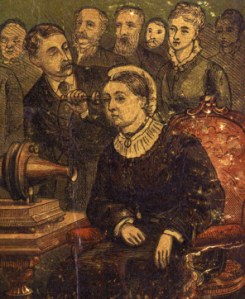
 The verb “to gaslight” comes from a 1938 stage play (which was then made into two movies, one starring Ingrid Bergman.) The plot is super-creepy, especially for 1938. In it, an evil husband tricks his young wife into believing she’s losing her mind by staging bizarre occurrences in their house, then pretending only she’s seeing and hearing them (yes, he’s after her money.) His favorite trick is dimming the gas lights in her room before clomping around upstairs or making strange sounds emanate from the walls. Soon she’s freaking out whenever the lights dim, expecting another bad trip. After each freak-out, once she’s good and melted down, he rushes to her aid, feigning concern.
 Are your Bloomsday plans still not nailed down?
 And it’s free. And Martin is handsome – and interesting – and English. And he’s a lawyer – a barrister, in fact (isn’t that adorable?!) And he’s titled this FREE webinar (did I mention that it’s free?)
 I’m thrilled and excited and flattered and deeply pleased to be participating as a panelist at the Penn Apalsa Conference on Saturday January 31, 2015. The theme is “Crescendo: Amplifying the Asian-American Voice”.
 “He lets me down every time. Why did I think this time would be different? Was it because I needed him so much?”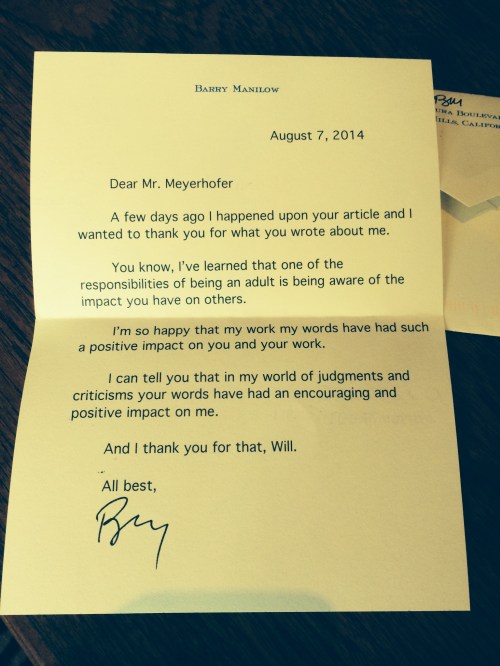
 It is remarkable how often I listen to clients worrying themselves sick over people who don’t even seem to like them.
 The answer was obvious. Every time she’d given in – and it had happened plenty – the same pattern played out. He was considerate and nice for a week or two, then went back to the same old routine of ignoring her needs and focusing entirely on himself.
 A friend of mine visited Las Vegas last year with his two elderly aunts, and – mostly to humor them – went to see Barry Manilow play at one of the big resort hotels. He posted his response up on Facebook: “I’m a fanilow!”
 Like most of you, I whiled away last Friday in New York City at the ultra-posh Yale Club, in attendance at an Above The Law-sponsored conference bearing the charming sobriquet: “Attorney@blog”.
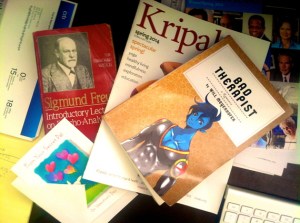 My new novel, Bad Therapist: A Romance, has been reviewed in the Huffington Post.
 The People's Therapist