I was recently interviewed by the lovely and talented Angela Kopolovich, for her blog. We talked about the relationship between self-esteem, lawyers and happiness. It turns out feeling good about yourself can go a long way towards making you feel happier. Who knew?
Here is a link to the interview. Hope you like it.
==========
My new book is a comic novel about a psychotherapist who falls in love with a blue alien from outer space. I guarantee pure reading pleasure: Bad Therapist: A Romance.
“I never thought I’d end up working as a contract attorney doing doc review in a windowless basement,” my client bemoaned. “But then I read that piece about the lawyer who’s working as a clerk at WalMart. At least I’ve still got it over him in terms of job prestige.”
Well, you know how obsessed lawyers are with job prestige.
There’s a phrase, “The Downward Drift,” that crops up in discussions of serious mental health diagnoses like schizophrenia, and/or chronic substance abuse. The idea is that you are afflicted with serious mental illness, or become addicted to a harmful substance, which in turn leads to a slow, inevitable slide downward in terms of social class. Before long, the wealthy, Upper East Side business executive suffering from schizophrenia and/or severe alcoholism finds himself jobless, friendless and eventually even homeless, sleeping in shelters and begging for change.
Weirdly, the same phenomenon – the Downward Drift – affects people who acquire Juris Doctor degrees. It sort of makes sense, since – at least nowadays, with people like me bellowing jeremiads on every street corner, it would be evidence of utter madness – textbook psychosis, perhaps – for anyone to head in the direction of law school, at least unless that law school is one of the top three in the country and someone else is footing the bill. But try to persuade a kid with a high LSAT score not to apply to law school – it’s nearly as tough as persuading a kid who’s gotten into a “top-500” (or whatever) law school into not attending (especially if he’s “won” one of those risible $20,000 so-called “scholarships” they hand out like pushers showering crack vials on newbie users.) If that task sounds Herculean (or Sisyphean), try talking a kid who’s blown $80,000 on his first year of law school out of “finishing up” the other two (useless) years – even if he’s hated every moment of the experience so far. This is where the parallel with addiction comes in because I guarantee you it’s no easier than convincing a chronic alcoholic that ten martinis is really enough. Even my own much-vaunted powers of persuasion come up short at that juncture. Because it’s impossible. An addict will keep drinking and drugging until he passes out face down in a puddle on the sidewalk. And a law student will blow that additional $160,000 to finish those two more pointless years. It’s a sure thing – just like zombies like eating flesh, the sun likes rising in the morning and Pat Robertson likes blaming bad weather on the homosexual agenda.
So how does the “Downward Drift” work, at least for lawyers?
Like most of you, I whiled away last Friday in New York City at the ultra-posh Yale Club, in attendance at an Above The Law-sponsored conference bearing the charming sobriquet: “Attorney@blog”.
If you failed to make an appearance, rest assured all was precisely as one would expect – celebrities galore, lavish swag, caviar in heaps, champagne flowing in torrents – all capped by innumerable late-night parties in painfully-hip underground destinations, guarded with zeal by the voluptuous ATL crew: Elie “The Beast” Mystal, Staci “Bootylicious” Zaretsky and the boss-man, David “Dr. Lovin'” Lat.
It was, in a word, legendary. I was in my element.
So. Here’s a music video of what we now laughing refer to as “the event,” although it was, in truth, more along the lines of a downtown “happening” à la Andy Warhol:
Thank you, wireLawyer, for recording history in the making. I’m pleased to report the camera caught my good side.
A special shout-out to my co-panelists, the simply-too-divine Vivia Chen and ever-hypnotic Jesse Kornberg.
See you next year.
==========
My new book is a comic novel about a psychotherapist who falls in love with a blue alien from outer space. I guarantee pure reading pleasure: Bad Therapist: A Romance
Here’s what you never hear anyone say at a Biglaw firm – followed by a discussion of why you never hear anyone say it.
Here we go…
Let’s work on this together. It’ll be more fun.
People write me all the time, complaining I’m too down on Biglaw. Nothing new there, but one guy, recently, expanded on the topic, adding that he works at a firm where everyone, so far as he knows, is happy – enjoying a rewarding career in a supportive, non-exploitative environment.
Perhaps you can see this coming: It turns out this guy owns the firm – and specializes in oral arguments before federal appellate courts. Prior to becoming managing partner, he attended top Ivy League schools.
By way of a reply, I opined: “Your experience might be considered atypical.”
In reality, his experience should be considered ridiculously atypical. Redonkulously atypical. Yet this presumably brilliant legal mind couldn’t manage to grasp that reality from where he was standing – at the top of the heap.
This man claims, without irony, that every lawyer at his firm is happy. But, that little voice in the back of your head begins to counter, before you’re even aware of having the thought: it’s your firm.
They work for you. Of course they act happy, just as the maid cleaning your hotel room – the one without a green card, with a family to feed, smiles and acts delighted to see you when you pop in to grab your extra iPad mini and she’s on her knees scrubbing the shower.
Presumably, someone else, some possibly unhappy little person at this guy’s law firm, is doing the work he would rather not think about – the work that has to be done. Maybe it’s a junior he’s never met. And I’d bet good money that other guy’s doing it all by himself, probably late at night or on a weekend.
I was naïve when I started at Sullivan & Cromwell. I’d been told to expect late nights and weekends. Somehow or other, though, I harbored the daft notion it would be okay because we’d be in it together. There’d be an esprit de corps, a collegial sense of loyalty to one another, and to the firm. We’d divvy up the assignments based on seniority and expertise, then plug away as a team – and maybe share a pizza and a few laughs in a conference room during breaks.
Instead, I found out what it felt like to have work dumped on me, without apology or explanation – work I had no idea how to do and barely understand (let alone cared about.) I learned what it felt like to endure weekend after weekend and night after night sitting utterly alone, alternately weepy and panicky, in an empty office tower, aching to return home, crawl into bed, and go to sleep, but knowing I couldn’t because that would get me fired, and I had loans, and no one else gave a damn about me or my misery because I didn’t matter one iota to their bottom line, which was money.
My friend, Dan Lukasik, who created the Lawyers with Depression website, asked me to post some information on his up-coming webinar, on Friday, February 7th, 2014 at 3 p.m. (E.S.T.), for lawyers with depression. I’ll let Dan take it from here:
======
Are You a Lawyer Who Has Problems Getting Things Done When Depressed?
If you’re a lawyer who struggles with depression, you’re not alone. Studies show that lawyers suffer from depression at a rate twice (20%) that of the general population. When put in perspective, that means that 240,000 of this country’s 1.2 million lawyers are struggling with depression right now.
These findings are not about sadness, the blues or even burnout, but true clinical depression. According to the Mayo Clinic, to be diagnosed with major depression by a health care professional you need to have some of the following symptoms most of the day, every day:
It seems oddly fitting that the words “caregiving” and “caretaking” mean precisely the same thing. Perhaps that linguistic oddity reflects the salient characteristic of care itself: a tension between our desire to receive it and our countervailing feeling of obligation to provide it. Human relations, generally, can be summarized as an on-going battle between those who provide care and those on the receiving end.
As a human child, you started out your life as the ultimate care-collection machine. Children are designed to make you want to provide them with care – and you’re designed, as an adult, to feel a profound impulse to provide children with care, especially your own children. It’s no coincidence that anything you identify as “cute” – i.e., feel an impulse to care for – will have child-like features, such as large eyes in proportion to its face and a large head in proportion to its body. These are all evolutionary triggers designed to make us feel like providing care.
The human instinct to care for youngsters transfers over to other young animals as well, and explains, at least in part, your relationship with “man’s best friend.” Everyone loves puppies – baby dogs. But with canines, the phenomenon extends further than that. Adult dogs retain many juvenile features – a phenomenon called “neoteny” – because by continuing to appear puppy-like up to and through adulthood, they can convince humans to keep wanting to offer them care. Dogs literally evolved to look young and cute just so you would care for them – and it’s worked! Unlike most species, the dog’s trick to evolutionary success wasn’t to display aggression, like a wolf. As evidenced by the wolf’s current struggle to survive in a human-dominated habitat, ferocity only gets you so far. For the dog, docility, rather than aggression, was the answer. By appearing cute – a bit like our own young – they mastered a strategy of symbiosis with another species, humans, with a strong instinct to provide care to their own young. The result is humans calling their dog “baby” and bragging to their friends that he’s “just like a member of the family.” In many respects, Fido actually is just like another child. Dogs are a bit like cuckoos in that respect – enlisting another species to do the work of raising their young – but in this case, by remaining young-looking throughout their adulthood, they lead another species to treat them like its own children for the duration of their lives.
Human children are also master care-harvesters – they have to be, because they remain dependent on adult care for survival for much longer than other species. Adult humans possess large brains, which could never fit through the human birth canal. Our children are thus, of necessity, born with a relatively tiny, undeveloped brain, leaving them utterly helpless and dependent on the care of others for many years. Humans thus possess a strong instinct to summon care as a child, but also a corresponding (and conflicting) instinct to provide care for helpless young humans. Awww…it’s a cute little baby. I want to take care of it.
Thus do we perpetuate our species. But this evolutionary arrangement sets up an internal battle between the child within you who’s hungry for care and the adult who feels obligated to provide it.
Spectating upon the atom bomb ignition at the Trinity test site in New Mexico, Robert Oppenheimer was reminded of a scene from the Bhagavad-Gita – an encounter between the prince and Vishnu, the latter apparently in a cranky frame of mind. The scene culminates in Vishnu, who is attempting to persuade the prince to do his duty, assuming a multi-armed form and intoning:
I have become death, destroyer of worlds.
There are lawyers out there who remind me of Vishnu in his multi-armed form. No, they don’t sprout extra limbs, or destroy entire worlds. These Biglaw-inspired incarnations of Vishnu merely assume the form of senior female attorneys to become career-death, destroyer of junior associates.
Behold the Biglaw Vishnus! (And trust me, within their personal sphere of destruction they give the real thing a run for his money.)
One of my clients fell victim to a Biglaw Vishnu – and his story is, as they say, far from atypical and so merits recounting.
He went, if not to a first-tier school, then to a first-and-a-half tier school, and by some rare stroke of fortune managed to locate a job, (if not at a first-tier firm, then at a first-and-a-half tier firm.)
It’s fair to say this guy was riding high – and gloating appropriately – when he happened to notice a problem: The firm had no work. His response was the same as everyone else’s around him – he twiddled his thumbs, wondering if he somehow smelled funny, or if, in fact (as it appeared) everyone else was twiddling their thumbs too (all while studiously pretending to be busy busy busy.) That situation endured for a year and a half, until my client was rudely stirred from this idyll by a partner, who delivered to him an awful review of the obviously-staged variety. (My client can’t remember if the problem they identified was that he asked for help too often instead of showing initiative or asked for help too rarely and wasted time by being too independent. He hadn’t billed an hour for months so he could hardly blame them for making something up.) As they say in California, “whatevers.” There was, however, a modicum of “fall-out.” Icarus-like, my client found himself plummeting in the unmistakable direction of every lawyer’s ultimate nightmare (at least officially): Unemployment. We all know the rules of this profession – five minutes of unaccounted-for time on your resume and it’s game over; you’ll never work as a lawyer again (well, maybe a staff attorney or doc reviewer but that hardly counts, does it?)
My client had three months to drum up a miracle. Following the world’s most intense job hunt, something came through at the eleventh hour. But there was a catch: He had to work for Vishnu.
The odometer rolled over today: 1,000,000 lifetime views.
Thanks for reading. ==========
Here’s my new book – a comic novel about a psychotherapist who falls in love with a blue alien from outer space – Bad Therapist: A Romance. I guarantee pure reading pleasure…
Please also check out The People’s Therapist’s legendary best-seller about the sad state of the legal profession, Way-Worse-Than-Being-Dentist
I was contacted last year by the very lovely Liz Brown to do an interview for her book, “Life After Law: Finding Work You Love with the JD You Have.”
Lo and behold – Liz’s book is out, and you can buy a copy.
You can also read her interview with me, courtesy of Business Insider. It is rather touchingly titled “This Miserable Law Grad Ditched Everything to be a Therapist for Unhappy Lawyers.” You can’t pay for publicity like that, and it’s an interesting piece – all about how I started out a corporate lawyer and wound up…here.
Thanks, Liz – and good luck with your new book!
==========
Here’s my new book – a comic novel about a psychotherapist who falls in love with a blue alien from outer space – Bad Therapist: A Romance. I guarantee pure reading pleasure…
Please also check out The People’s Therapist’s legendary best-seller about the sad state of the legal profession, Way-Worse-Than-Being-Dentist
I had the pleasure of sitting down for an interview last week with Spencer Mazyck, of Bloomberg Law, at their studio in Midtown. I’m happy to report Spencer is the nicest guy in the world and this was the most fun I’ve ever had.
The discussion was far-ranging. I’m used to talking about the state of the legal profession, but Spencer asked me about my life, my loves – and just about everything else.
My new book is a comic novel about a psychotherapist who falls in love with a blue alien from outer space. I guarantee pure reading pleasure: Bad Therapist: A Romance
(In addition to Amazon.com, my books are also available on bn.com and the Apple iBookstore.)
It’s time to go back to 1972 or so and start the Women’s Liberation movement up all over again. We need it.
A client, who was sexually harassed at her old firm, tells me a new fear haunts her – that her “reputation” will be transported via gossip to wherever she goes next. I asked what that “reputation” would be – I mean, how do you get a reputation for being harassed by some clown at a law firm?
“Well, they might think I’m difficult, or unstable, or a trouble-maker,” she explained.
That makes me want to scream – particularly because she might be right: Some sort of reputation along those lines might stick to her, and it might get around at her new firm. When you’re a woman at a law firm – or a woman, period – there are times when it seems you just can’t win.
Another client – a young partner at a biglaw firm – told me she’d been harassed, but stated flatly, “you can’t report it – they’ll just push you out.” I asked her what she did instead. “Oh, you’re supposed to be able to handle it. Tell him to fuck off, or whatever.”
That was upsetting to hear. She delivered it with gusto – and I wanted to believe she really meant it, had the fortitude to say “fuck off” to the guy slipping his hand up her thigh, then briskly smooth her skirt, and move on. But is it really that easy?
Therapists love empathy exercises – it’s kind of our business, in a nutshell. So let’s go ahead and imagine the reality of sexual harassment – having someone you have no interest in sexually or otherwise, someone you work with or work for, pawing over your body at a firm function. My guess is it would unsettle me more than I’d like to admit. And how about going into the office the next day and trying to work with the guy – especially if he’s senior? Could you just “handle it”? Or would the whole unpleasant business get under your skin, leave you seething, angry and humiliated and wanting someone to listen to what happened to you and do something about it? And what would you do with the thought that he’s probably doing this to other people, and getting away with that, too?
The People’s Therapist has joined the bloviating classes…I’ve now appeared as a talking head on a real live (sort of) television talk show – HuffPost Live.
The segment seemed to go well, although I had the unnerving if not atypical sensation of being the hot-headed radical spouting fire at a garden party. Hélas, c’est mon destin. At least my hair looked good. At least, I think it did.
This time around, blessedly, the other panelists weren’t biglaw partners, law professors and authors of books with titles like “You can be super-duper happy as a lawyer if you just smile a lot!” Been there, done that.
For a rather gloomier view of the current nightmare that is biglaw, click here.
It must be admitted, it is fun to be on tv and get to talk.
==========
My new book is a comic novel about a psychotherapist who falls in love with a blue alien from outer space. It’s called Bad Therapist: A Romance. I guarantee pure reading pleasure…
If you’re a lawyer appearing at my doorstep, and you work in biglaw, there’s a good chance you’re seeking a way out. You don’t know what you want to do next, but the status quo is insupportable. That’s the standard set-up.
If you’re a lawyer appearing at my doorstep and you work in biglaw, we’ll likely talk about the challenges ahead. Trapped in the bathysphere of biglaw, it’s hard to see out let alone get out. You’ve heard rumors about human beings who enjoy their jobs. In your experience, big firm attorneys loathe their chosen profession the way other people breathe air.
If you’re a lawyer appearing at my doorstep, and you work in biglaw, we’ll probably talk about a sideways shuffle I call the “crab-walk.” You can’t transfer from a big law firm directly to a tolerable work environment in one leap – the chasm between biglaw and anywhere anyone would want to be is too great. Crab-walking is the next best thing, based on the indisputable principle that a tiny step in the direction of somewhere else amounts to an improvement. Take a reduced schedule at your current firm (if such a thing exists in theory or practice.) Give a “kinder, gentler” mid-law shop a shake. Go in-house at a bank. Dial for dollars as a headhunter. Switch to consulting and live in a hotel in Indianapolis all week writing reports recommending the firing of middle managers. Get a sales and support position at WestLaw teaching summers to concoct search terms. Small crab-walk-y steps remove you one centimeter at a time from where you are right now. That, by definition, is good.
If you’re a lawyer appearing at my doorstep and you work in biglaw, you probably want out, and have since your first taste of the Kool-Aid. You need to hear you’re not crazy or alone, and that there are others who long for a job without constant anxiety attacks, where Sunday nights aren’t a horror show, where a partner won’t tell you without a trace of irony to “go ahead and take the weekend off,” where it isn’t considered an easy night to get home at 11 pm.
These generalities hold true for about 96% of the lawyers appearing at my doorstep who work in biglaw. They do not, however, apply to everyone.
I don’t want to exaggerate the phenomenon, but there are folks who actually “fit in” in biglaw. They actually like it there. These are the “odd ducks,” and from time to time some of them also appear at my door.
What a pleasant surprise to listen in to the second podcast of Legally Obligated and find myself a part of the show! The lovely host, June, closes her podcast by reading a section from the introduction to Way Worse Than Being a Dentist.
Thanks for the shout-out (or read-out), June. I’m proud to be a part of your excellent series.
You can listen to the podcast here. Be sure to catch the entire show – very interesting stuff in there about former law students suing law schools and an interview with an attorney who left the profession.
For more information on June and her blogging activities, click here.
For more information on “Way Worse” and all my books, click here.
If law students are annoying, then pre-law students are twice as annoying. There’s something about observing these lemmings scrabble their way into the maws of ruthless law schools, despite dire warnings and appeals to common sense, that just…gets under my skin.
Even after so much effort has been expended for their benefit – i.e., which part of “Way Worse Than Being a Dentist” didn’t you understand? – these piteous creatures patiently queue up for their punishment, hungry to “learn to think like a lawyer.” If your resolve weakens, and pity prevails over contempt, you might mistakenly engage one in conversation. For your trouble, you’ll receive an earful of a clueless pipsqueak’s master plan to save the world. Because – you hadn’t heard? – that’s why he’s going to law school: The betterment of humanity.
Because that’s what the world so desperately needs: Another lawyer.
Somehow or other, these automata get it into their programming that, if they actually did want to save the world, becoming a lawyer would be a sensible way to do it. They are unaware of how imbecilic their words sound to anyone not entirely befuddled by the miasma of law school propaganda.
Law schools inundate proto-lawyers with ‘lawyers save the world’ nonsense, cramming their crania with musty tales of Brown v Board of Ed. That’s because the schools are well aware of the likely effect of such indoctrination: Greasing the rails to the killing floor. If a kid can tell himself he’s going to “change the world” – as opposed to, say, “make a lot of money and feel like a big deal” – then he’ll line up that extra bit more smugly for the $160k/year that makes his eyes roll up into his head and a little string of drool form at the corner of his mouth.
It’s simple: If you can tell yourself you’re doing it for the good of humankind, you won’t feel so guilty selling out in the most soulless, stereotypical way imaginable.
Someone posted the following astonishing comment in response to one of my columns a few months back:
“I’ve never worked in a biglaw firm, but what happens if an associate just says no, I am busy this weekend, or no, I am on vacation that week, so I won’t be able to do that project. Do you immediately get fired? If that’s true, then you must not really have much to offer to the firm in the first place. In a situation where the associate had some real value to offer to the firm, I do not see why the firm would fire someone for that. Am I hopelessly naive?”
Go ahead – laugh. Get it out of your system. You know perfectly well your guffaws wear thin, right about when that twinge of poignancy creeps in. You, too, once mulled the notion of rising above the fray – going all Bartleby the Scrivener and muttering “I’d prefer not to” when asked – oops, I mean told – to work and work and work and work and work.
This “pure fool” of a comment-writer has raised a troubling issue (and that, by the way, was a combined Parsifal and Magic Mountain reference…this will be one of those classy columns larded with literary allusions.) Cower behind your carapace of cynicism, but sooner or later you’ll admit you weren’t always like this. You weren’t always a broken, cynical wreck who jumps at the slightest command. You used to be Bartleby The Scrivener, too. You imagined you were valued as a unique, complex individual. You imagined you held some sway over your own existence – some “preferences.”
I know it’s no fun trying to remember the stuff you read in college, but please attempt to keep up. Even if you weren’t an undergraduate English major, you might recall that the narrator of “Bartleby the Scrivener” was called “The Lawyer.” That’s right: “The Lawyer.” The whole thing takes place in a law firm! And remember what a scrivener did? It was the worst job in the firm – probably one of the worst jobs of all time. You sat at a desk copying legal documents – handwriting them – for hours. Reminiscent of doc review, or due diligence, or “running changes” – scrivening was mindless and, if you kept at it for too long, guaranteed to drive you bat-shit. You – and everyone else – would obviously “prefer not to.”
And yet, somehow or other, our narrator – “The Lawyer” (i.e., a partner at the firm) – is astonished when Bartleby, after being asked politely to scriven something, even more politely states in return: “I’d prefer not to.” The Lawyer explains his astonishment at Bartleby’s resistance by pointing out how he, as a partner – even in 1853! – possesses a “natural expectancy of instant compliance.”
You know all about that, right? The “natural expectancy of instant compliance”? Sure you do.
First – yes, this blog, and my columns on AboveTheLaw.com, are coming back to life – or will be shortly. I’m just waiting for the new book to come out (and no, the new book is not what you’re expecting.)
More immediately, for all my Hong Kong readers, here’s a fun event coming up on the evening of November 20th, 2012, featuring wine and canapes:
I look forward to the opportunity to meet more of my readers and share a few thoughts about the madness of biglaw. Hope you can make it.
Will
PS: If you’re in NYC On October 26th, 2012 and would like to hear me opine upon the divine absurdities attendant to biglaw, please come to the 2012 Fall Symposium of the National Association of Legal Search Consultants (NALSC), where I’ll be a featured speaker – information is available here.
========
If you’re interested in the scientific and philosophical underpinnings of psychotherapy, you might enjoy my first book, Life is a Brief Opportunity for Joy
I participated recently in a panel discussion at a conference, speaking with other lawyer/blogger types in front of an audience consisting largely of people from law firms and law schools.
After we finished, I did the decent thing and sat and listened to the panel that followed mine. I happened to choose an empty seat next to a woman who introduced herself to me later as a Dean at a law school, in charge of career placement, or whatever the euphemism is for trying to find students non-existent jobs. The law school was obscure – one of those dreaded “third tier” places.
She confronted me afterwards. “I guess I’m the bad guy, huh?”
I was startled by her candor, but knew what she meant. This was one of those people from a third tier law school – the greedy cynical fraudsters signing kids up for worthless degrees, then leaving them high and dry – unemployed and deeply in debt.
Despite her participation in crimes against humanity, I had to admit she didn’t seem so bad, in person.
Then I snapped back to my senses – and went on the attack, assuming my sacred role as The People’s burning spear of vengeance.
“At very least, you have to admit the tuition is too high,” I vituperated.
“Don’t talk to me about tuition,” she rejoined. “It’s the tenured faculty – that’s where that money’s going.”
She took a step closer and lowered her voice, taking me into her evil confidence.
“I’ll tell you what I’m looking at. I’ve got to find kids jobs – that’s it, my assignment. Here’s how bad it’s gotten. Someone called the other day and said ‘I’m getting evicted – you have to find me something, anything.’”
Her face looked dead serious. She wanted The People’s burning spear of vengeance to hear this.
“I called in every favor – I called everyone I knew. What more can I do?”
I acknowledged her point, grudgingly. Maybe this was a lesser villain. Perhaps some vestige of good remained in her corrupted, blackened soul.
“The best thing,” she continued, “and it’s going to happen – will be a bunch of schools shrink their class sizes or close down completely.”
She paused while we mutually processed the implications – namely, that she’d lose her job.
“That would be the best thing,” she repeated for emphasis, as though daring me to believe her. I did.
I left the conference chewing over the big question: If that lady I’d just met, and chatted with, was Lucifer herself – then she failed to convince. In which case, who’s left? Who is the Great Satan?
Will Meyerhofer, JD LCSW-R is a psychotherapist in private practice in TriBeCa, in New York City.
You can visit his private practice website at: www.aquietroom.com.
Will holds degrees from Harvard, NYU School of Law and The Hunter College School of Social Work, and used to be an associate at Sullivan & Cromwell before things changed...
Now, in addition to his work as a psychotherapy, he writes books and blog entries and a column for AboveTheLaw.com.
The People’s Therapist writes books
The first book is called "Life is a Brief Opportunity for Joy"
 terviewed by the lovely and talented Angela Kopolovich, for her blog. We talked about the relationship between self-esteem, lawyers and happiness. It turns out feeling good about yourself can go a long way towards making you feel happier. Who knew?



 Like most of you, I whiled away last Friday in New York City at the ultra-posh Yale Club, in attendance at an Above The Law-sponsored conference bearing the charming sobriquet: “Attorney@blog”.
 Here’s what you never hear anyone say at a Biglaw firm – followed by a discussion of why you never hear anyone say it.
 My new novel, Bad Therapist: A Romance, has been reviewed in the Huffington Post.

 It seems oddly fitting that the words “caregiving” and “caretaking” mean precisely the same thing. Perhaps that linguistic oddity reflects the salient characteristic of care itself: a tension between our desire to receive it and our countervailing feeling of obligation to provide it. Human relations, generally, can be summarized as an on-going battle between those who provide care and those on the receiving end.
 Spectating upon the atom bomb ignition at the Trinity test site in New Mexico, Robert Oppenheimer was reminded of a scene from the Bhagavad-Gita – an encounter between the prince and Vishnu, the latter apparently in a cranky frame of mind. The scene culminates in Vishnu, who is attempting to persuade the prince to do his duty, assuming a multi-armed form and intoning:
 The odometer rolled over today: 1,000,000 lifetime views.
 I was contacted last year by the very lovely Liz Brown to do an interview for her book, “Life After Law: Finding Work You Love with the JD You Have.”


 The People’s Therapist has joined the bloviating classes…I’ve now appeared as a talking head on a real live (sort of) television talk show – HuffPost Live.
 If you’re a lawyer appearing at my doorstep, and you work in biglaw, there’s a good chance you’re seeking a way out. You don’t know what you want to do next, but the status quo is insupportable. That’s the standard set-up.
 What a pleasant surprise to listen in to the second podcast of Legally Obligated and find myself a part of the show! The lovely host, June, closes her podcast by reading a section from the introduction to Way Worse Than Being a Dentist.
 If law students are annoying, then pre-law students are twice as annoying. There’s something about observing these lemmings scrabble their way into the maws of ruthless law schools, despite dire warnings and appeals to common sense, that just…gets under my skin.
 Someone posted the following astonishing comment in response to one of my columns a few months back: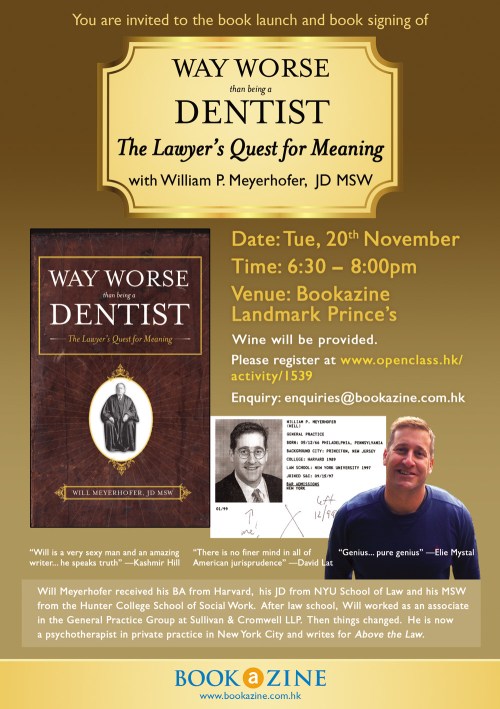
 I participated recently in a panel discussion at a conference, speaking with other lawyer/blogger types in front of an audience consisting largely of people from law firms and law schools.

 The People's Therapist